
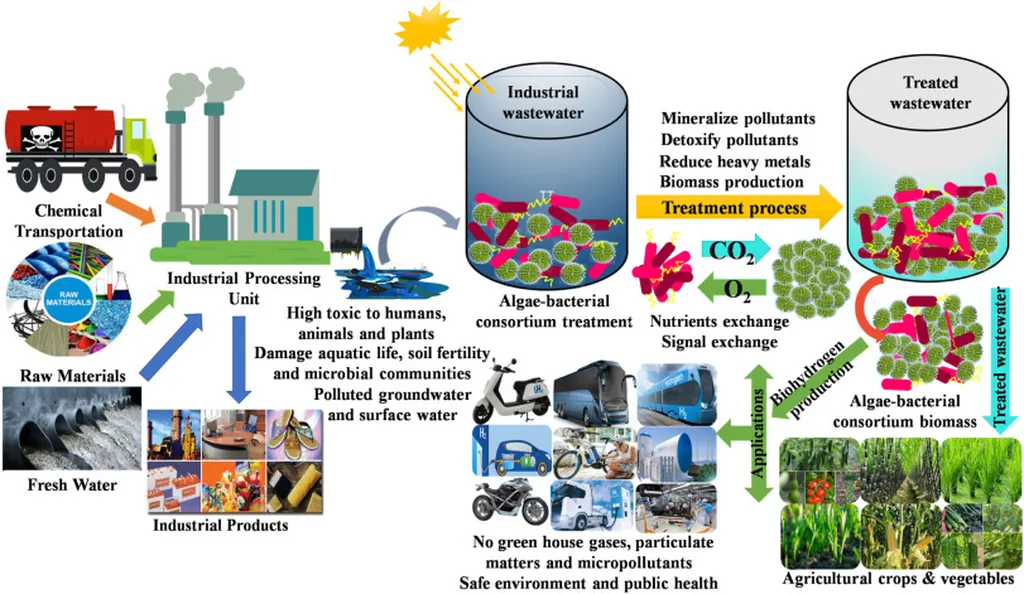
In the quest to clean up industrial wastewater, a team of researchers from Nanjing Tech University’s Department of Municipal Engineering has made a significant breakthrough. Led by Xuyang Shi, the team has developed an innovative method to degrade crystal violet (CV) dye, a stubborn pollutant known for its harmful effects on organisms. Their work, published in the journal *Applied Water Science* (translated as “Applied Water Science”), could have substantial implications for the energy sector and other industries grappling with dye pollution.
Crystal violet is a recalcitrant triphenylmethane dye, notorious for its carcinogenic, mutagenic, and teratogenic properties. It’s a common pollutant in wastewater from textile, paper, and leather industries, posing significant environmental and health risks. The challenge has always been to find an efficient and cost-effective way to break down this dye.
The researchers turned to Arthrobacter, a genus of bacteria known for its biodegradation capabilities. However, free bacteria have limitations, such as sensitivity to environmental conditions and difficulty in recycling. To overcome these hurdles, the team embedded the bacteria in a composite matrix made of biochar and sodium alginate, then coated it with chitosan. This immobilization process enhanced the bacteria’s stability and reusability.
The results were promising. Under optimal conditions—30°C, pH 7, and an initial CV dye concentration of 100 mg/L—the immobilized bacterial agent achieved a remarkable 90% decolorization efficiency. “The immobilized bacterial agent not only degraded the dye but also converted it into less toxic compounds, Michler’s ketone and N, N-dimethylaminophenol,” Shi explained. This significant reduction in toxicity was further confirmed by a seed germination test. While seeds irrigated with untreated CV dye had a germination rate of only 37.78%, the rate soared to 80.00% after a 48-hour treatment with the immobilized bacterial agent.
The implications for the energy sector and other industries are substantial. Wastewater treatment is a critical aspect of sustainable industrial operations, and this new method could offer a more efficient and eco-friendly solution. “This work establishes that the immobilized bacterial agent demonstrates considerable promise for CV dye degradation and markedly diminishes its toxicological impact,” Shi stated. The method could potentially reduce the cost and environmental impact of wastewater treatment, paving the way for more sustainable industrial practices.
The research, published in *Applied Water Science*, opens up new avenues for exploring the use of immobilized bacterial agents in wastewater treatment. As industries strive for more sustainable and efficient operations, such innovations could play a pivotal role in shaping the future of environmental management. The study not only highlights the potential of Arthrobacter in dye degradation but also underscores the importance of innovative immobilization techniques in enhancing bacterial efficiency and reusability. This could be a game-changer for industries looking to minimize their environmental footprint while maximizing operational efficiency.