
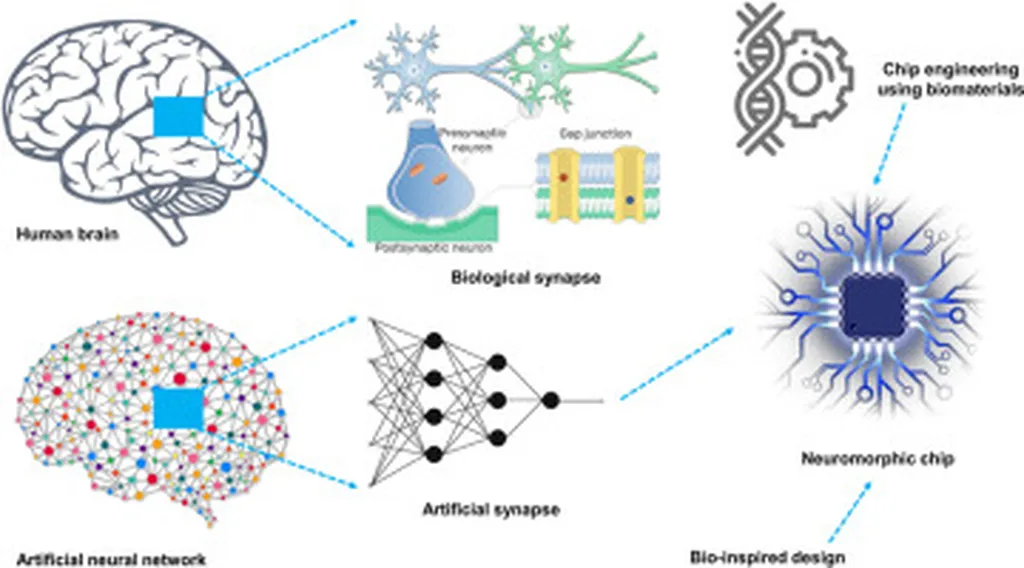
In a groundbreaking development poised to reshape the landscape of neuromorphic computing, researchers have unveiled a novel bio-inspired neural system that mimics the energy efficiency and sensory-processing capabilities of biological neurons. This innovation, detailed in a recent study published in the *International Journal of Extreme Manufacturing* (translated as *International Journal of Extreme Manufacturing*), could have profound implications for the energy sector and beyond.
At the heart of this research is a monolithic neuromorphic platform developed by a team led by Jiaqi Li from the School of Nano-Tech and Nano-Bionics at the University of Science and Technology of China, in collaboration with the Suzhou Institute of Nano-Tech and Nano-Bionics, Chinese Academy of Sciences. The platform integrates cascaded single-walled carbon nanotube thin-film transistors (SWCNT TFTs) with Mini-light-emitting diodes (Mini-LEDs) and optoelectronic synaptic transistors, achieving a synergistic optoelectronic integration.
“This work represents a significant advancement toward high-density, energy-efficient neuromorphic computing,” said Li. “By leveraging the unique properties of carbon nanotubes and optoelectronic components, we have created a system that closely emulates the functionality of biological neurons.”
The SWCNT TFTs in this system exhibit dual functionality, serving as both highly stable active-matrix drivers and efficient optoelectronic synaptic devices. Fabricated at wafer-scale with micrometer feature sizes, these devices demonstrate exceptional performance metrics, including low operating voltages, high on/off ratios, and precise Mini-LED current regulation. The optoelectronic synaptic devices, formed between poly (3,3’’’-didodecyl quaterthiophene) (PQT-12) and semiconducting SWCNTs, enable broadband photoresponses through efficient charge transport driven by TFT-controlled Mini-LED pulses.
One of the most compelling aspects of this research is its potential to overcome the limitations of traditional von Neumann architecture, which separates memory and processing functions. By replicating the unified sensory-processing capabilities of biological neurons, this bio-inspired system could revolutionize data processing and energy efficiency in various applications.
“The implemented bio-inspired visual system successfully emulates fundamental synaptic functionalities, such as excitatory postsynaptic currents (EPSC), short-term potentiation (STP), and long-term potentiation (LTP),” Li explained. “This represents a significant step forward in our quest to develop more efficient and powerful computing systems.”
The research team demonstrated the system-level functionality of their platform through a five-layer convolutional neural network, achieving an impressive 92.02% accuracy on MNIST classification. This achievement underscores the potential of the monolithic integration to establish a biomimetic closed-loop “electrical-optical-electrical” pathway that faithfully simulates complete biological synaptic operation.
As the world grapples with the energy demands of increasingly complex computing systems, this research offers a promising path forward. By mimicking the efficiency of biological neurons, the bio-inspired neural system could significantly reduce energy consumption in data centers and other high-performance computing environments.
“This pioneering cascade of electronic, photonic, and optoelectronic components represents a significant advancement toward high-density, energy-efficient neuromorphic computing,” Li noted. “We believe that this work will pave the way for future developments in the field, with wide-ranging applications in the energy sector and beyond.”
With its potential to transform data processing and energy efficiency, this research marks a significant milestone in the pursuit of more sustainable and powerful computing technologies. As the world continues to demand more from its digital infrastructure, innovations like this bio-inspired neural system could play a crucial role in meeting those needs while minimizing environmental impact.