
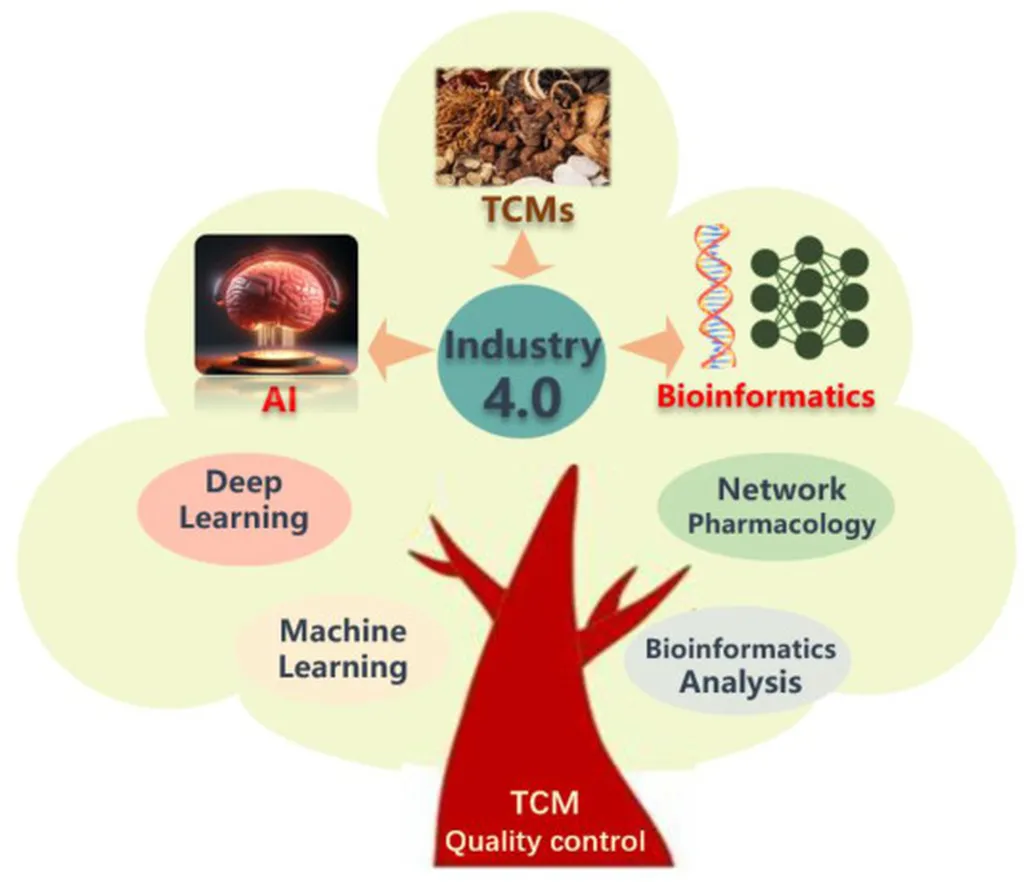
In the heart of China, researchers at the University of Science and Technology of China have developed a groundbreaking biosensor that could revolutionize the quality control of herbal medicines. Led by Jacob Wekalao from the Department of Optics and Optical Engineering, this innovative sensor combines terahertz technology, metamaterials, and artificial intelligence to detect isoquercitrin, a crucial bioactive compound in herbal medicines, with unprecedented accuracy and speed.
The sensor, detailed in a recent study published in *Nanocomposites* (which translates to *Nanocomposites* in English), is a marvel of modern engineering. It leverages terahertz waves, which lie between microwaves and infrared light on the electromagnetic spectrum, to interact with the molecules of interest. The sensor’s metamaterial design, optimized through COMSOL simulations, enhances its sensitivity to an impressive 300 GHz·RIU⁻¹, allowing it to detect even minute refractive index changes as small as 0.05 RIU.
Wekalao explains, “The integration of AI has been a game-changer. Our one-dimensional convolutional neural network has achieved a near-perfect predictive capability, with R² values up to 1.00 across diverse conditions. This means our sensor can provide highly accurate and reliable results, even in complex environments.”
The implications for the herbal medicine industry are profound. Currently, quality control processes can be time-consuming and prone to human error. This new sensor offers a rapid, accurate, and scalable solution. “By enabling fast, precise, and consistent quantification of bioactive compounds, our system sets a new benchmark for analytical methodologies in natural product research,” Wekalao states.
The sensor’s precision is further validated by its stable performance metrics, including a 0.015 THz full width at half maximum (FWHM) and a Quality Factor of approximately 47. This level of accuracy is crucial for ensuring the efficacy and safety of herbal medicines, which are increasingly gaining global recognition for their therapeutic benefits.
Beyond the immediate applications in the herbal medicine industry, this research opens up exciting possibilities for other sectors. The combination of terahertz spectroscopy, metamaterial-enhanced signal amplification, and AI-driven modeling could be adapted for use in various fields, including environmental monitoring, food safety, and even medical diagnostics.
As the world continues to embrace natural and alternative medicines, the need for robust quality control measures becomes ever more critical. This innovative biosensor, developed by Wekalao and his team, is poised to meet this need head-on, shaping the future of the herbal medicine industry and beyond. The study’s publication in *Nanocomposites* underscores its significance and potential impact on the scientific community and commercial sectors alike.
In the words of Wekalao, “This synergistic approach offers a transformative solution for standardizing and quality-controlling botanical therapeutics. It’s not just about improving existing methods; it’s about setting a new standard for the future.”