
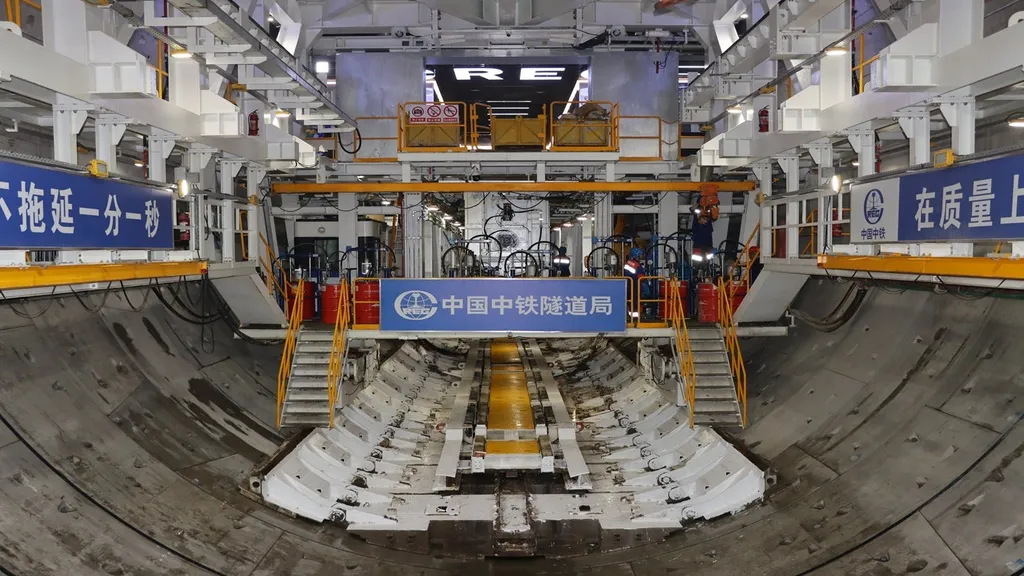
In the intricate world of tunneling engineering, a recent study has shed new light on the dynamics of steel casing construction between parallel tunnels, with significant implications for the energy sector. Led by XU Zeyu of The Third Construction Co., Ltd. of China Construction Fifth Engineering Bureau, the research employs a sophisticated coupling method of the discrete element method (DEM) and finite difference method (FDM) to analyze the influences of backspin construction of steel casing.
The study, published in *Yantu gongcheng xuebao* (translated to *Rock and Soil Mechanics*), delves into the load-deformation characteristics of tunnels and soil layers under three distinct working conditions: double-tunnel-static pressure, double-tunnel backspin, and single tunnel backspin. The findings are compelling, revealing that the transverse displacement caused by backspin construction is a substantial 163.5% of that under static pressure. Moreover, the transverse and vertical deformations under single tunnel conditions increase by 32.7% and 53.4%, respectively, compared to double tunnels.
“Backspin can effectively reduce the convergence deformation of segments,” notes lead author XU Zeyu. This insight is crucial for engineers and project managers in the energy sector, where tunneling is a critical component of infrastructure development. The research highlights that the convergence displacement under single tunnel conditions is twice that under double tunnels, a factor that could significantly impact project timelines and costs.
The study also underscores the importance of monitoring the rotation index, which increases and then decreases with the vertical displacement of the steel casing. The maximum value occurs near the displacement of the casing to the tunnel arch, a critical point for ensuring structural integrity.
For the energy sector, these findings are particularly relevant. Tunneling is a fundamental aspect of energy infrastructure, from the construction of pipelines to the development of underground storage facilities. Understanding the dynamics of steel casing construction can lead to more efficient and cost-effective projects, ultimately benefiting both developers and consumers.
As the energy sector continues to evolve, the insights from this research could shape future developments in tunneling engineering. By adopting the appropriate segment reinforcing measures at different stages of construction, engineers can enhance the safety and efficiency of their projects. The study’s emphasis on the dynamic construction process of steel casing serves as a reminder of the complex interplay between technology and practical application in the field.
In an industry where precision and efficiency are paramount, this research offers valuable guidance for professionals seeking to optimize their tunneling operations. As the energy sector continues to grow and adapt, the lessons learned from this study will undoubtedly play a pivotal role in shaping the future of tunneling engineering.