
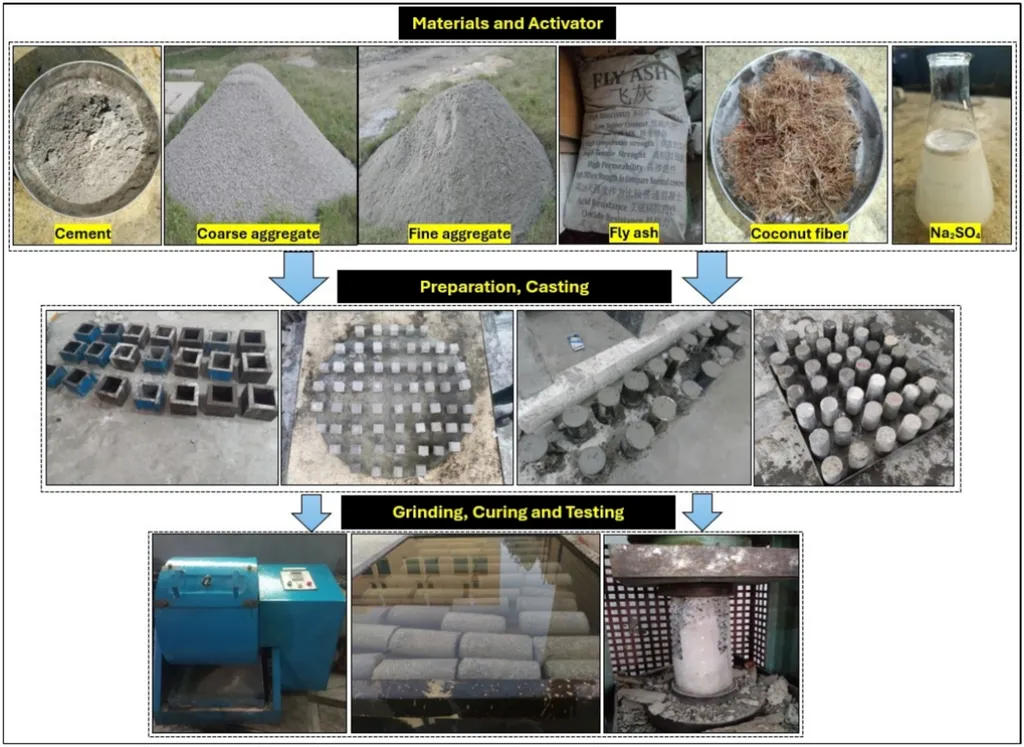
In the quest for sustainable construction, researchers are turning to industrial by-products to create eco-friendly concrete mixtures that don’t compromise on strength. A recent study led by Rawa Aree JAMAL from the Civil Engineering Department at the American University of Iraq Sulaimani, published in the *Journal of Materials and Engineering Structures* (translated as “Journal of Materials and Structural Engineering”), explores the potential of fly ash, ground granulated blast furnace slag (GGBFS), and granite powder to enhance the tensile strength of concrete, paving the way for greener construction practices.
The study analyzed 252 experimental samples, using five statistical models to predict tensile strength based on various input parameters. Among these models, the Full Quadratic (FQ) model stood out, demonstrating the highest accuracy with the lowest residual error. This model was followed closely by the Interaction (INT) model, indicating the complex interplay of factors influencing concrete strength.
“Our findings confirm that optimizing the water-to-cement and cement-to-sand ratios can significantly improve the performance of eco-friendly concrete,” said JAMAL. This optimization is crucial for the energy sector, where the demand for durable, sustainable materials is growing. By incorporating industrial by-products, construction companies can reduce their environmental footprint while maintaining the structural integrity of their projects.
The sensitivity analysis conducted in the study identified key parameters affecting tensile strength, including curing time, pull-off layer thickness, and the cement-to-sand ratio. These insights provide a roadmap for engineers and construction professionals looking to enhance the performance of their concrete mixtures.
The commercial implications of this research are substantial. As the energy sector increasingly prioritizes sustainability, the demand for eco-friendly construction materials is expected to rise. By adopting these innovative concrete mixtures, companies can not only meet regulatory requirements but also appeal to environmentally conscious clients.
“This research demonstrates that it is possible to balance mechanical performance with environmental sustainability,” JAMAL noted. This balance is essential for the future of construction, as the industry seeks to reduce its carbon footprint without sacrificing quality.
The study’s findings were published in the *Journal of Materials and Engineering Structures*, a testament to the rigorous scientific process behind this groundbreaking research. As the construction industry continues to evolve, the insights from this study will undoubtedly shape future developments, driving the transition toward greener, more sustainable practices.
In an era where sustainability is no longer optional, this research offers a promising path forward, one that aligns with the growing demand for eco-friendly solutions in the energy sector and beyond.