
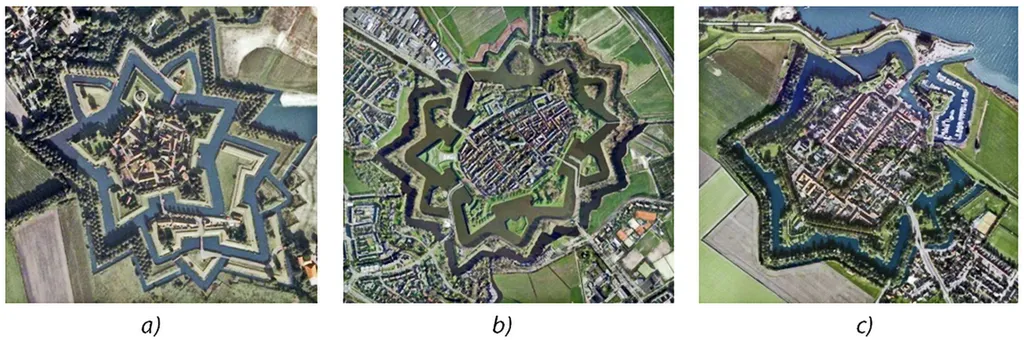
In the realm of historical military architecture, a new study is shedding light on the intricate dance between theory and practice that shaped the fortifications of the sixteenth century. Vincenzo Cirillo, a researcher from the University of Campania Luigi Vanvitelli, has delved into the treatise “Della Fortificatione delle città” (1564), edited by Girolamo Maggi and attributed to the engineer Iacomo Castriotto. This work, published in the journal ‘Informes de la Construccion’ (translated to ‘Construction Reports’), offers a fresh perspective on how drawing techniques and geometric principles were pivotal in the design and execution of defensive structures.
The study highlights the innovative use of Euclidean geometry and geometric matrices in the ideation and representation of fortified architecture. “The treatise provides a unique window into the scientific reasoning of the time,” Cirillo explains. “It shows how engineers like Castriotto used these mathematical tools not just for theoretical exploration, but for practical application in the field.”
One of the most compelling aspects of the research is its focus on planimetric schemes and proportional rules. These methods were crucial in connecting the dots between theoretical designs and the actual construction of fortifications. “The instruments for calculating distances and heights described in the treatise were revolutionary for their time,” Cirillo notes. “They allowed engineers to bridge the gap between the drawing board and the battlefield.”
The treatise is situated within the broader evolution of Renaissance military treatises, from De Lanteri to Lorini, and is compared with key contributions by Tartaglia, Ryff, and Dürer. This comparative analysis underscores the treatise’s innovative and methodological value, showing how it synthesized scientific reasoning with practical application.
So, what does this mean for the future of architectural and engineering practices? The study suggests that understanding the historical foundations of military architecture can provide valuable insights for modern design and construction. “By examining the methods and techniques of the past, we can gain a deeper appreciation for the principles that underpin contemporary engineering practices,” Cirillo says.
The research also has implications for the energy sector, particularly in the design and construction of secure facilities. The principles outlined in the treatise could inspire new approaches to fortification and defense, ensuring that critical infrastructure remains protected in an increasingly complex world.
As we look to the future, the lessons from the past become increasingly relevant. The study by Cirillo not only enriches our understanding of sixteenth-century military architecture but also offers a roadmap for innovation in the present. By bridging the gap between theory and practice, we can continue to push the boundaries of what is possible in the field of construction and engineering.