
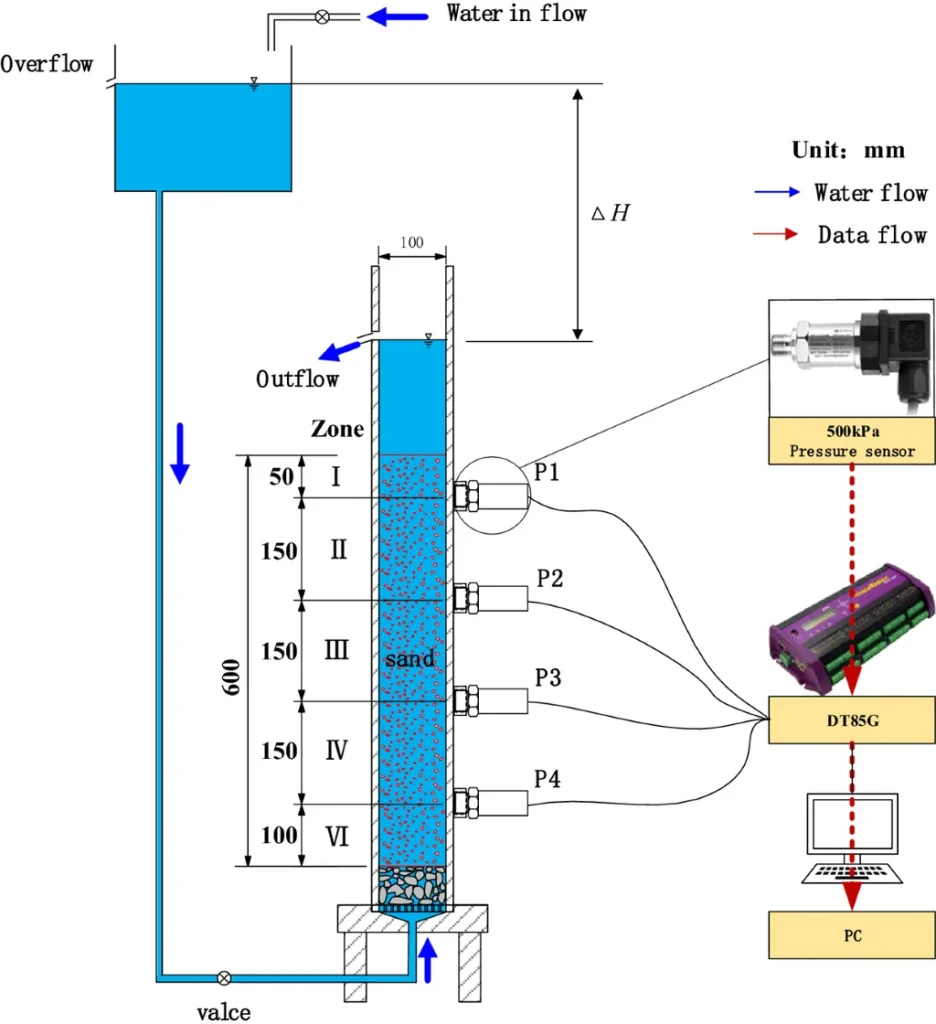
In the world of hydraulic engineering and water resource management, understanding the behavior of muddy water seepage through coarse-grained soils is crucial for designing efficient and durable infrastructure. A recent study published in *Yantu gongcheng xuebao* (translated as *Rock and Soil Engineering*) sheds new light on this complex interplay, offering insights that could revolutionize how we approach anti-filtration design and seepage control in hydraulic engineering.
Led by Dr. Mao Haitao from the College of Urban and Rural Construction at Shanxi Agricultural University and Dr. Zhang Chao from the School of Civil Engineering at Chongqing Three Gorges University, the research team delved into the intricate dynamics of particle migration and clogging in coarse-grained soil columns. Their findings reveal that the seepage of muddy water has a profound impact on the porosity and permeability of these soils, which are essential factors in the stability and efficiency of hydraulic structures.
The study employed a custom-built seepage apparatus to investigate how different compositions of muddy water, varying non-uniform coefficients of coarse-grained soil columns, and different hydraulic heads influence the infiltration characteristics of particles. The team derived a differential equation to calculate seepage with variable permeability coefficients, a significant advancement in the field.
One of the most compelling discoveries was the identification of four distinct clogging morphologies: surface accumulation clogging (S type), surface-internal dual clogging (S-I type), internal pore clogging (I type), and transient pore clogging (P type). These morphologies are dictated by the content of particles with a control size (C0.075), which plays a pivotal role in the migration, deposition, and clogging of particles within the soil columns.
“Understanding these morphologies is crucial for predicting the long-term behavior of hydraulic structures,” said Dr. Mao. “The migration of particles becomes more challenging as the non-uniform coefficient of the coarse-grained soil increases, and the porosity decreases. This has significant implications for the design and maintenance of embankments and other hydraulic infrastructures.”
The study also highlighted the impact of hydraulic head on particle migration. While it intensifies the velocity of particle movement, it also accelerates their deposition and clogging at the top of the soil columns. This insight is particularly relevant for the energy sector, where efficient water management is critical for operations such as hydroelectric power generation and water storage.
Dr. Zhang emphasized the practical applications of their findings: “Our research provides a more accurate understanding of how muddy water interacts with coarse-grained soils. This knowledge can be used to optimize the design of hydraulic structures, ensuring they are more resilient and efficient over time.”
The implications of this research extend beyond immediate practical applications. By offering a deeper understanding of the coupled effects between coarse and fine particles during seepage, the study paves the way for more sophisticated theoretical models and design approaches. This could lead to more robust and sustainable hydraulic engineering solutions, benefiting industries that rely on efficient water management.
As the energy sector continues to evolve, the insights from this study will be invaluable for developing innovative strategies to manage water resources effectively. The research not only advances our scientific understanding but also offers practical tools for engineers and policymakers to create more resilient and efficient hydraulic infrastructures.
In the rapidly changing landscape of water resource management, this study stands as a testament to the power of interdisciplinary research. By bridging the gap between theoretical models and practical applications, it sets a new standard for how we approach the challenges of seepage and clogging in hydraulic engineering. As Dr. Mao and Dr. Zhang continue their work, their findings will undoubtedly shape the future of this critical field.