
In the heart of bustling cities, subway stations are the lifeblood of urban transportation, connecting people and driving economic engines. Yet, these vital hubs face an often-overlooked threat: earthquakes. A recent study published in *Yantu gongcheng xuebao* (translated as *Chinese Journal of Geotechnical Engineering*) by researchers from Tongji University, led by ZHANG Chenlong and colleagues, sheds light on how to assess and enhance the seismic resilience of shallow-buried subway stations, offering a roadmap for safer, more robust urban infrastructure.
The study, which includes contributions from ZHANG Dongming, HUANG Zhongkai, and HUANG Hongwei, all affiliated with the College of Civil Engineering and the Key Laboratory of Geotechnical and Underground Engineering at Tongji University, introduces a comprehensive framework to evaluate the resilience of subway stations. The framework considers the uncertainty of seismic intensity, a critical factor often overlooked in traditional assessments.
“Subway stations are not just transportation hubs; they are the arteries of urban life,” says lead author ZHANG Chenlong. “When they fail, cities grind to a halt. Our research aims to change that by providing a robust method to assess and improve their resilience.”
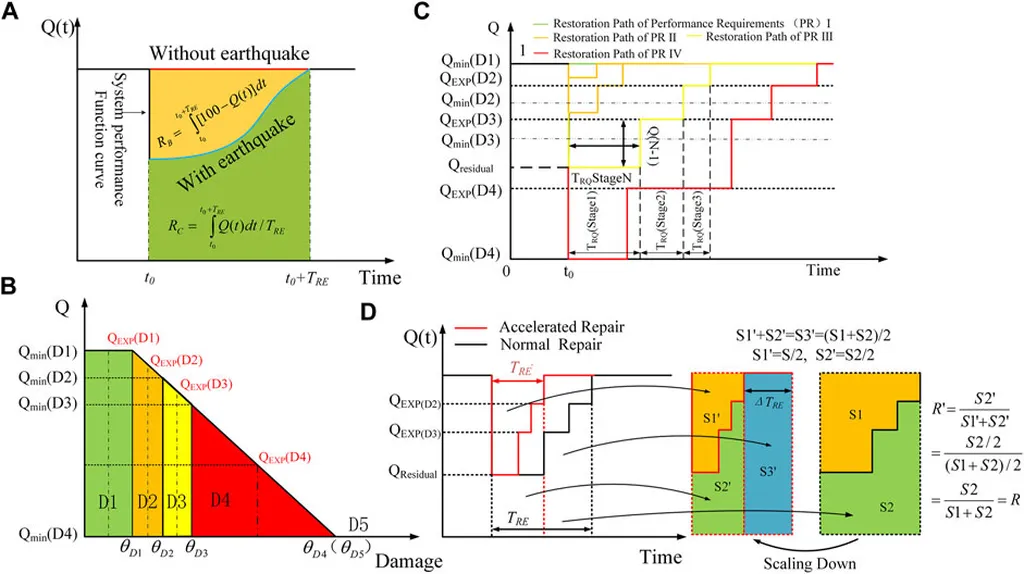
The researchers utilized finite element software to build detailed numerical models of subway stations and conducted extensive simulations using a wide range of seismic motions. This approach allowed them to derive vulnerability functions based on peak ground acceleration, quantifying the likelihood of damage at various levels. By employing Monte Carlo simulations, they further refined their assessments, accounting for the inherent uncertainty in seismic intensity.
The study also delves into the economic implications of seismic damage, integrating damage probabilities with economic loss models. This holistic approach provides a clearer picture of the financial impact of earthquakes on subway stations, a crucial consideration for decision-makers in the energy and transportation sectors.
“Understanding the economic impact is just as important as understanding the physical damage,” explains ZHANG Chenlong. “Our framework helps cities allocate resources more effectively, ensuring that critical infrastructure can withstand and recover from seismic events.”
The research highlights the importance of performance recovery models, site conditions, and disaster preparedness time in enhancing seismic resilience. By evaluating these factors, the study offers actionable insights for engineers and policymakers, enabling them to design and manage subway networks with resilience in mind.
The implications of this research extend beyond subway stations. As cities continue to grow and urban infrastructure becomes increasingly complex, the need for resilient design becomes paramount. This study provides a blueprint for assessing and enhancing the resilience of critical infrastructure, ensuring that cities can withstand and recover from seismic events with minimal disruption.
“Our goal is to create cities that are not just connected but resilient,” says ZHANG Chenlong. “By integrating resilience into the design and management of subway networks, we can build urban environments that are safer, more efficient, and better prepared for the challenges of the future.”
As urban populations continue to grow and the demand for reliable transportation increases, the findings of this study offer a timely and crucial contribution to the field. By providing a comprehensive framework for assessing seismic resilience, the research paves the way for safer, more resilient cities, benefiting not only the transportation sector but also the broader economy.