
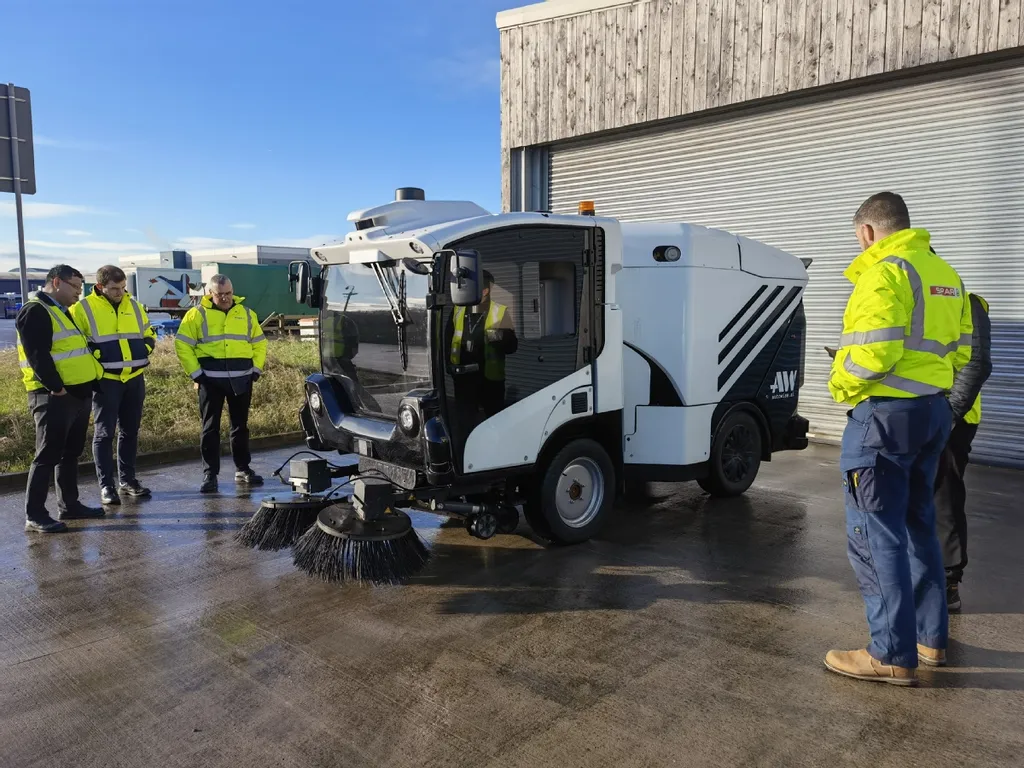
In the quest for cleaner roads and more efficient municipal cleaning systems, a team of researchers led by Y. Xu from the Key Laboratory of Intelligent Pure Electric Sanitation Vehicles at Anhui Polytechnic University in China has made significant strides. Their work, published in the journal *Mechanical Sciences* (which translates to *Mechanical Science and Technology*), delves into the intricate dynamics of sweeping and suction systems used in road sweepers. The research offers promising insights that could revolutionize the design and operation of these essential vehicles, with potential ripple effects across the energy sector.
At the heart of this study is a sophisticated computational model that combines computational fluid dynamics (CFD) with the discrete element method (DEM). This powerful tool allows researchers to simulate the complex interactions between airflows and solid particles within a sweeper’s sweeping-suction system. “Our model captures the dynamic response of particles under the combined effects of disk-brush-induced turbulence and suction nozzle negative pressure,” explains Xu. This level of detail is crucial for understanding how different operational parameters influence cleaning efficiency.
The team conducted extensive parametric studies, varying brush angles, rotational speeds, and suction pressures to observe their effects on particle transport. Their findings reveal that optimal cleaning performance is achieved when the brush angle is within a specific range, the rotational speed is between 130 and 160 revolutions per minute, and the suction pressure is maintained between -2.6 and -2.8 kPa. These parameters are not just arbitrary numbers; they represent a delicate balance that maximizes the system’s ability to capture and remove particles from road surfaces.
One of the most intriguing aspects of the study is the flow field analysis, which shows a gradual spatial coupling between the rotational airflow induced by the brush and the suction field. This coupling forms a stable high-speed adsorption zone, which is critical for efficient particle capture. The research also highlights that smaller particles are more susceptible to deviations from the ideal collection path due to flow non-uniformity. This insight could lead to more precise control mechanisms and improved designs that minimize particle escape.
The implications of this research extend beyond the immediate realm of road cleaning. As cities around the world strive for cleaner and more sustainable urban environments, the efficiency of municipal cleaning systems becomes increasingly important. Optimizing these systems can lead to significant energy savings and reduced operational costs, which are critical considerations for the energy sector. Moreover, the advanced modeling framework developed by Xu and his team offers a valuable tool for future research and development in this field.
“Our proposed CFD–DEM framework demonstrates high accuracy and applicability in resolving gas–solid interactions and particle motion in sweeping operations,” says Xu. This framework not only provides theoretical guidance for parameter optimization and structural design but also paves the way for innovative solutions that could transform the way we maintain our roads and cities.
As the world continues to grapple with environmental challenges, research like this offers a beacon of hope. By understanding the fundamental dynamics of cleaning systems, we can develop more efficient and sustainable technologies that contribute to cleaner air, healthier communities, and a more sustainable future. The work of Y. Xu and his team is a testament to the power of scientific inquiry and its potential to drive meaningful change in the world.