
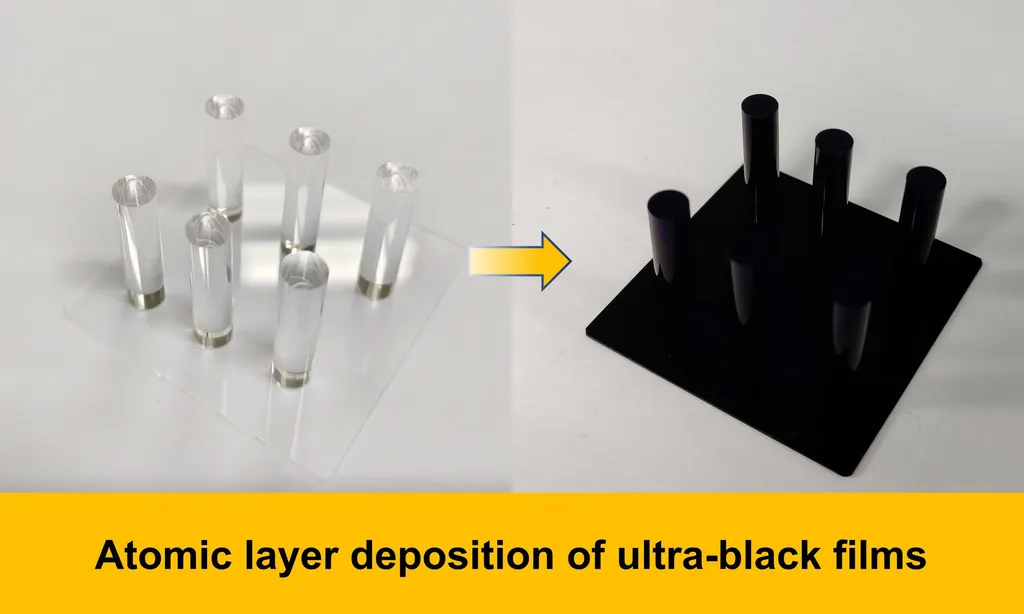
In the quest to enhance the performance of space optical systems, a team of researchers from the Harbin Institute of Technology has made a significant breakthrough in the development of ultra-black coatings. These coatings, designed to suppress stray light, could have profound implications for the energy sector and beyond.
The research, led by Liu Sainan of the State Key Laboratory of Space Power-Sources, focuses on the design and fabrication of an ultra-black, high-absorptance thermal control coating suitable for the harsh environment of space. The coating, formulated using carbon black nanoparticles as the filler and inorganic potassium silicate as the binder, has demonstrated an impressive ability to absorb light.
According to the study published in *Cailiao Baohu* (which translates to *Materials Protection*), the coating maintains an optical absorptance of 99.9% even at a 60° incidence angle. This high absorptance is achieved at a carbon black volume fraction of 2% and a surface roughness of σrms = 2.0 μm. The experimental results confirmed that the sprayed ultra-black coating achieved an absorptance of 99.2% under the same conditions, showing high consistency with the simulation.
The implications of this research are vast. In space optical systems, stray light can significantly degrade the performance of imaging and detection instruments. By suppressing this stray light, the new coating can enhance imaging contrast and detection sensitivity, thereby improving the overall performance of the system in complex space environments.
But the potential applications extend beyond space. In the energy sector, for instance, high-absorptance coatings can be used to improve the efficiency of solar panels. By absorbing more light, these panels can generate more electricity, making them more cost-effective and environmentally friendly.
“The development of this ultra-black coating is a significant step forward in the field of optical coatings,” said Liu Sainan, the lead author of the study. “Its high absorptance and wide-angle performance make it a promising solution for a range of applications, from space optical systems to solar energy.”
The research also highlights the importance of computational modeling in the design and fabrication of advanced materials. By using the Maxwell-Garnett effective medium model and the Fresnel equations, the team was able to calculate the influence of filler volume fraction on the spectral absorption characteristics of the coating. Furthermore, the finite-difference time-domain method was employed to simulate the electromagnetic field of coatings with randomly rough surfaces, providing valuable insights into the absorption behavior of smooth and rough coatings under different incident angles.
This study not only provides a promising technical solution for developing advanced stray light suppression coatings in space optical systems but also paves the way for future developments in the field of high-absorptance materials. As the demand for more efficient and effective optical systems continues to grow, the need for advanced coatings like this one will only increase. The research team’s work is a testament to the power of innovation and the potential of advanced materials to shape the future of technology.