
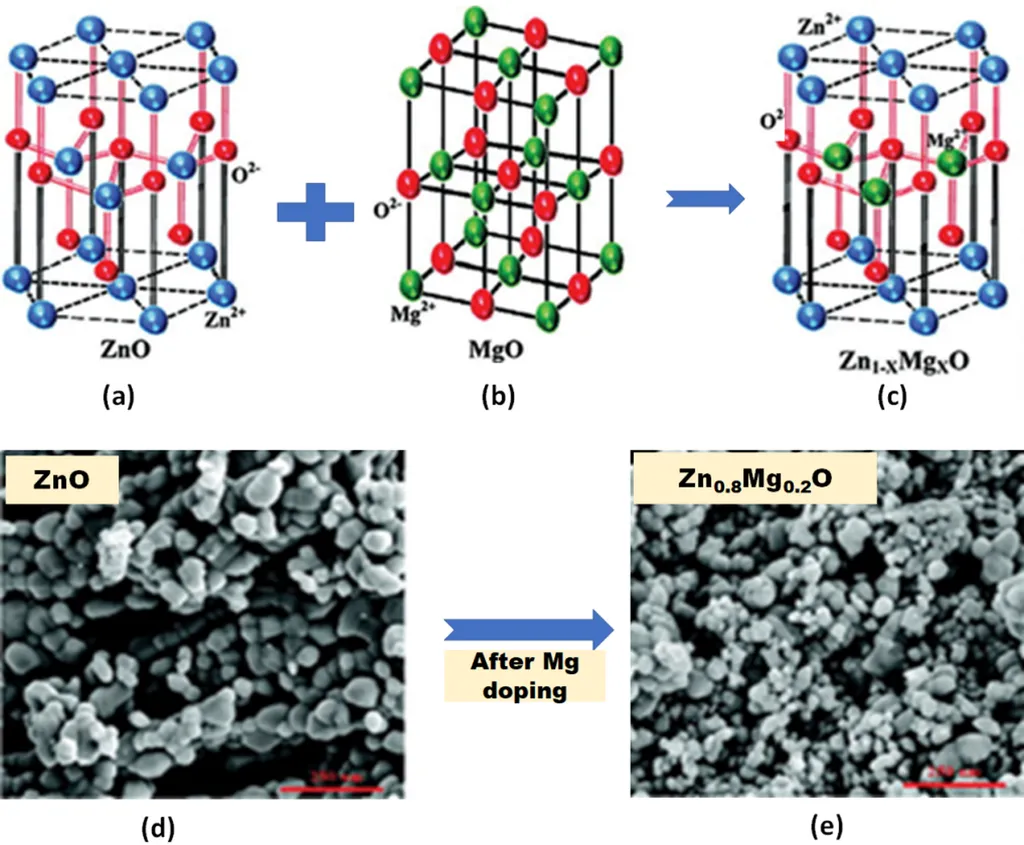
In the quest to harness the sun’s energy more efficiently, researchers are delving into the intricate world of materials science, seeking to tweak the properties of existing compounds to enhance their performance in solar cells. A recent study published in the journal *Materials Research Express* (which translates to *Journal of Materials Research and Application* in English) has shed light on the potential of magnesium-doped zinc titanate (ZnTiO₃) to revolutionize the energy sector.
Sujeet Kumar Pandey, a researcher from the Department of Chemical and Biochemical Engineering at Rajiv Gandhi Institute of Petroleum Technology in India, led a team that employed first-principles and density-functional-theory calculations to investigate the structural and electronic properties of pure and magnesium-doped zinc titanate. The goal was to understand how magnesium substitution could alter the electronic structure of ZnTiO₃, potentially making it more suitable for solar cell applications.
The team’s findings revealed that the introduction of magnesium impurities at a doping level of 0.333 significantly reduced the electronic structure gap of ZnTiO₃ while maintaining its indirect electronic structure gap. “The investigation of structural and electronic characteristics indicates that x = 0.333 Mg doped ZnTiO₃ significantly reduces the electronic structure gap of ZnTiO₃,” Pandey explained. This reduction in the band gap is crucial for enhancing the material’s ability to absorb sunlight and convert it into electrical energy.
The study also validated the exchange–correlation treatment and pseudopotentials employed for the band-structure calculation, ensuring the accuracy of their findings. “The density functional theory study shows that Mg substitution in ZnTiO₃ changes their electronic structure and density of states, and the experimental band gap is nearly the same as the computational band structure gap,” Pandey added.
The implications of this research are profound for the energy sector. By fine-tuning the band gap of ZnTiO₃ through magnesium doping, researchers can potentially develop more efficient solar cells that capture a broader spectrum of sunlight. This advancement could lead to significant improvements in solar energy conversion rates, making solar power a more viable and competitive energy source.
Moreover, the study’s findings could pave the way for further exploration of band-gap engineering in other materials, opening up new avenues for innovation in the field of renewable energy. As the world continues to seek sustainable and clean energy solutions, research like this brings us one step closer to a future powered by the sun.
In the words of Pandey, “This research not only validates our computational methods but also provides a promising direction for the development of next-generation solar cells.” The journey towards a greener future is filled with challenges, but with each scientific breakthrough, we edge closer to unlocking the full potential of renewable energy.