
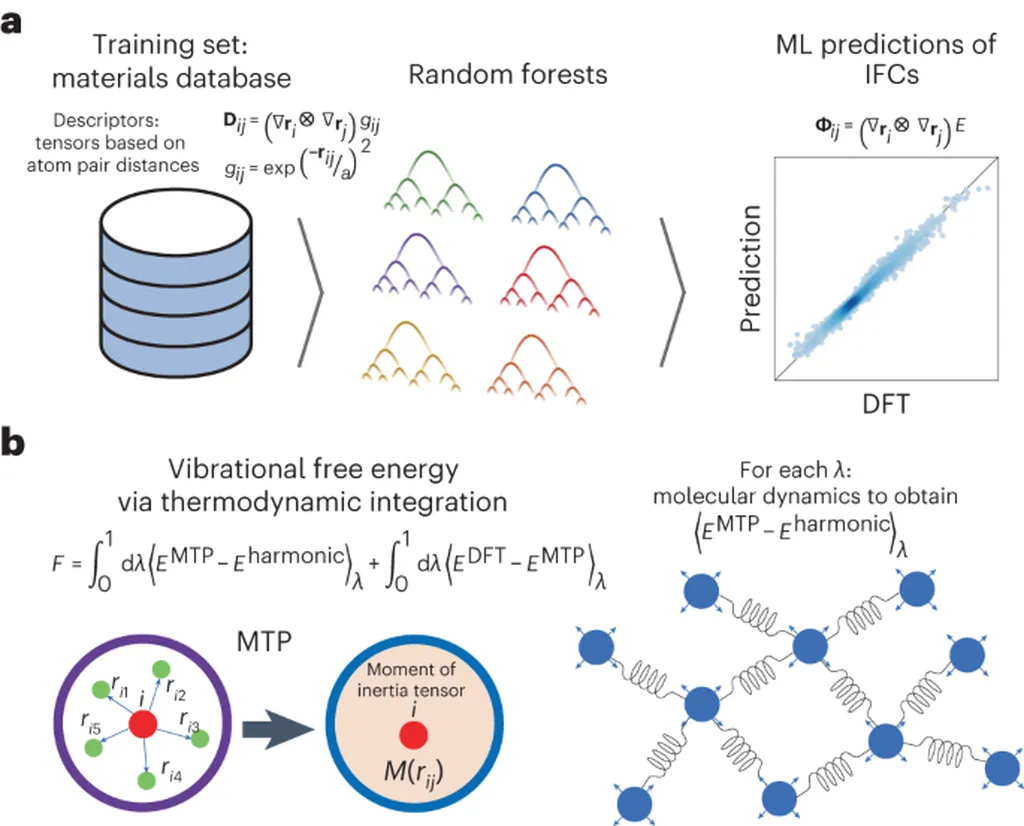
In the quest to revolutionize material discovery, a groundbreaking study led by Dr. V Torlao from the Department of Physics at Mindanao State University–Main Campus in the Philippines has introduced a novel deep learning model that predicts the stability of chemical compounds with unprecedented accuracy. Published in the journal *Materials Research Express* (translated to English as “Materials Research Express”), this research could significantly impact the energy sector by accelerating the development of advanced materials for energy storage, conversion, and efficiency.
The study focuses on predicting the formation energy of material crystal structures, a critical factor in determining a compound’s stability. “Understanding the stability of materials is fundamental to their practical application,” Torlao explains. “Our model leverages the composition of materials, their crystallographic symmetry, and stability labels to provide a comprehensive framework for predicting formation energy.”
The deep neural network model developed by Torlao and his team incorporates elemental fractions derived from material composition, along with crystallographic symmetry (space group) and stability labels (ground state, metastable, unstable). The inclusion of symmetry information, which represents the crystal polymorphs, proved to be a game-changer. “The addition of symmetry information markedly enhanced the model’s predictive accuracy,” Torlao notes. “This is crucial for understanding phase transitions in materials, which is essential for their practical applications.”
The model’s performance was further improved by incorporating stability labels, demonstrating that combining compositional, structural, and thermodynamic descriptors yields a more robust prediction framework. This advancement underscores the importance of crystallographic symmetry and stability information in enhancing the accuracy and interpretability of deep learning models for materials stability.
The implications of this research are vast, particularly for the energy sector. Accelerated material discovery could lead to the development of more efficient batteries, better catalysts for fuel cells, and advanced materials for solar energy conversion. “This research opens up new possibilities for the energy sector,” Torlao says. “By predicting the stability of materials more accurately, we can fast-track the development of materials that are crucial for energy storage and conversion technologies.”
The study’s findings, published in *Materials Research Express*, highlight the potential of deep learning in material science. As the energy sector continues to evolve, the ability to predict and understand the stability of materials will be crucial in driving innovation and efficiency. Torlao’s research not only advances our understanding of material stability but also paves the way for future developments in the field, offering a glimpse into a future where deep learning plays a pivotal role in shaping the materials of tomorrow.
In an era where the demand for sustainable and efficient energy solutions is at an all-time high, this research provides a beacon of hope, illustrating how the intersection of physics, chemistry, and artificial intelligence can drive transformative change. As we stand on the brink of a new era in material science, the work of Dr. V Torlao and his team serves as a testament to the power of interdisciplinary collaboration and the boundless potential of deep learning in unlocking the secrets of the material world.