
In the heart of Tbilisi, Georgia, a groundbreaking study is unfolding that could reshape the way we think about reinforcing concrete structures. Tamaz Khmelidze, a researcher from the Department of Construction Machinery at Georgian Technical University, has been delving into the bond between basalt composite reinforcement and concrete, and his findings are nothing short of intriguing.
Khmelidze’s research, published in the English-language journal ‘AGG+’ (Aggregates and Construction Materials), focuses on the stress-deformation state of the bond between Georgian-origin basalt composite reinforcement and concrete. His work is not just theoretical; it’s rooted in practical, experimental research that could have significant implications for the construction and energy sectors.
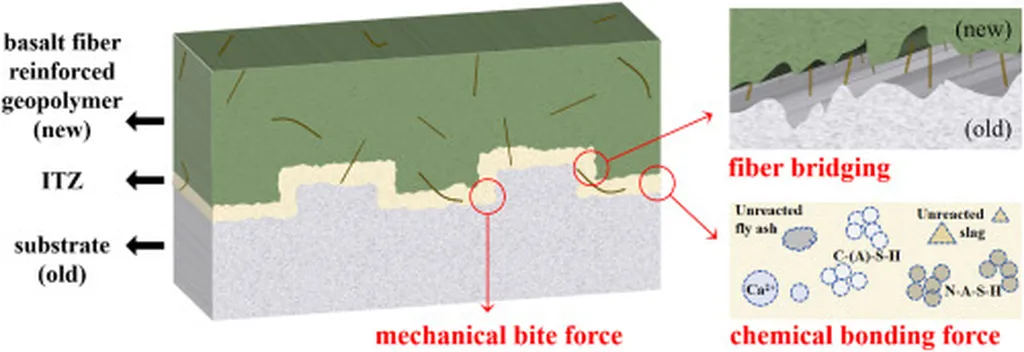
The study reveals the bonding mechanism between basalt composite reinforcement and different classes of concrete. “We’ve found that the bond strength between concrete and basalt reinforcement, at the moment of failure, exceeds the cohesive strength of concrete in the boundary zone,” Khmelidze explains. This is a crucial finding, as it indicates that basalt composite reinforcement could potentially enhance the overall strength and durability of concrete structures.
But what does this mean for the energy sector? Concrete is a fundamental material in the construction of energy infrastructure, from power plants to wind turbines. The use of basalt composite reinforcement could lead to more robust and long-lasting structures, reducing maintenance costs and improving safety. Moreover, basalt is a natural, abundant material, making it an eco-friendly choice that aligns with the energy sector’s increasing focus on sustainability.
Khmelidze’s research also derived an empirical formula for calculating the anchorage length of basalt-plastic reinforcement in concrete. This formula could simplify the design and construction processes, making basalt composite reinforcement a more practical and attractive option for engineers and architects.
The potential applications of this research are vast. As Khmelidze puts it, “The results of our experimental-theoretical research will be applied in the calculations of real concrete structures, taking into account the bond stresses between basalt reinforcement and concrete.” This could pave the way for innovative designs and constructions that push the boundaries of what’s currently possible.
In the ever-evolving landscape of construction materials and techniques, Khmelidze’s work stands out as a beacon of innovation. It’s a testament to the power of experimental research and theoretical analysis in driving progress. As the energy sector continues to grow and adapt, the insights gleaned from this study could play a pivotal role in shaping the future of construction.