
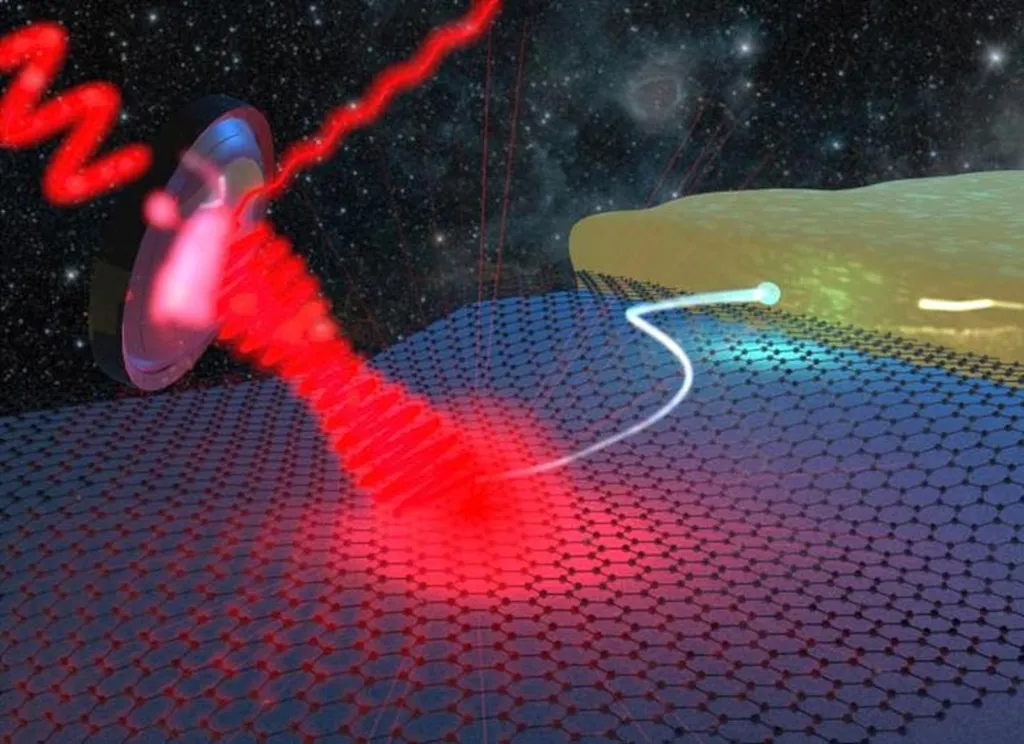
In the bustling world of materials science and construction technology, a groundbreaking development has emerged that could reshape how we manipulate terahertz waves, a critical frequency range for advanced communication and energy applications. Researchers, led by Guang Zhao from the School of Electronic Engineering at Tianjin University of Technology and Education in China, have introduced a novel terahertz metasurface decoder. This innovation leverages a triple-meander-line filter structure, integrating graphene to achieve dynamic tunability, potentially revolutionizing the energy sector.
The study, published in *Materials Research Express* (which translates to *Journal of Materials Research and Application*), proposes a terahertz metasurface decoder that employs a unique triple-meander-line filter design. By incorporating controllable openings into each level of the metallic arms, the researchers achieved a structure combination logic akin to a 3–8 decoder. This allows for multi-state terahertz response modulation, a feature that could be game-changing for industries relying on precise frequency control.
“Our design enables distinct frequency-domain characteristics within the range of 0.303–0.576 THz, which is a significant advancement in the field of terahertz technology,” said Guang Zhao, the lead author of the study. The integration of graphene as a dynamically tunable material further enhances the decoder’s capabilities. By modulating the Fermi energy, the researchers achieved controllable conductive switching without altering the physical geometry, paving the way for dynamically reconfigurable terahertz devices.
The implications for the energy sector are profound. Terahertz waves are increasingly being explored for applications in energy transmission, sensing, and communication. The ability to dynamically reconfigure terahertz devices could lead to more efficient energy systems, improved data transmission rates, and enhanced sensing capabilities. This research establishes a novel design paradigm and theoretical framework for terahertz metamaterial devices, featuring logic-mapping functionality, high reconfigurability, and electrical tunability.
As the world continues to seek innovative solutions to energy challenges, advancements like this terahertz metasurface decoder offer a glimpse into a future where technology and energy systems are more interconnected and efficient. The study not only highlights the potential for advanced applications but also sets the stage for further exploration and development in the field of terahertz technology.
In the words of Guang Zhao, “This work opens up new possibilities for the design and application of terahertz devices, potentially transforming how we approach energy and communication systems.” As researchers and industry professionals continue to build on these findings, the future of terahertz technology looks brighter than ever.