
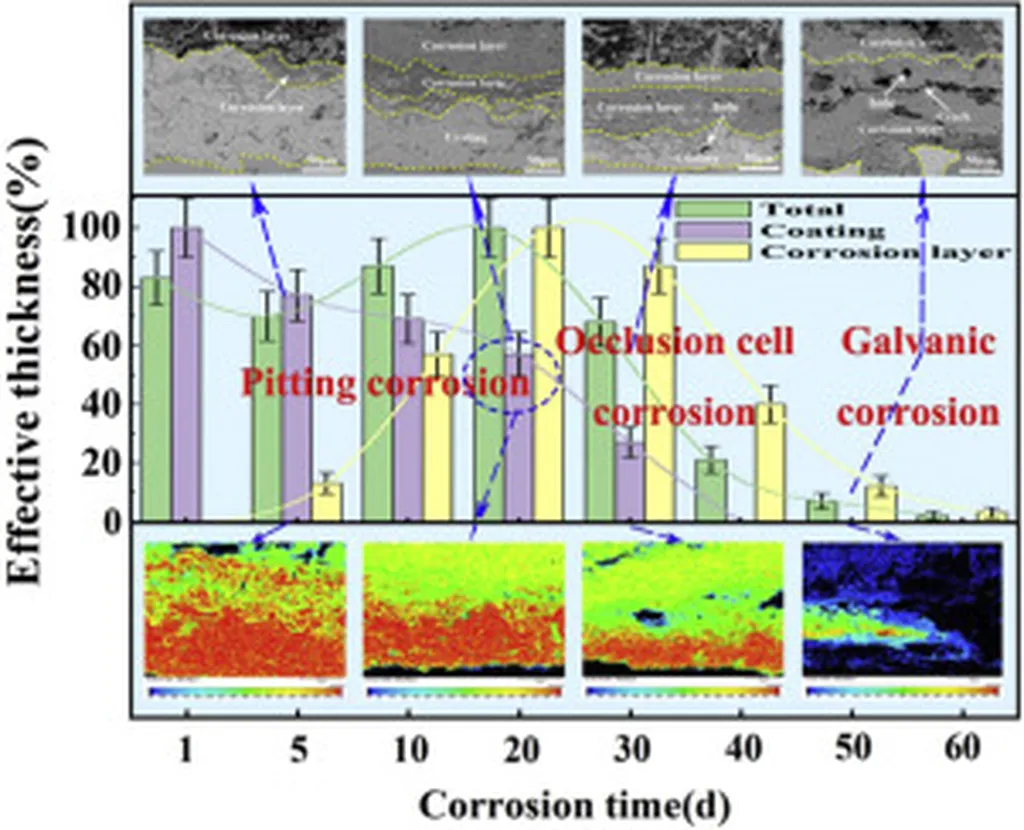
In a significant stride towards enhancing the durability of Zn-Cu-Ti alloy sheets, a team of researchers led by Liu Yang from Xiangtan University and Zhuzhou Smelter Group Co., Ltd. has unveiled a comprehensive study on the growth and corrosion resistance of phosphate coatings. Published in the esteemed journal ‘Cailiao Baohu’ (translated to ‘Materials Protection’), this research delves into the intricate details of phosphating treatments and their impact on the microstructure and corrosion resistance of these alloys.
The study, which involved a meticulous analysis using X-ray diffraction (XRD), scanning electron microscopy (SEM), X-ray photoelectron spectroscopy (XPS), and a 5% NaCl immersion test, revealed that the phosphating time plays a pivotal role in the performance of the phosphate films. As the phosphating time increased, the phosphate film gradually grew, and its coverage improved. However, the sweet spot was found at 105 seconds, where the film exhibited a distinct granular structure and optimal corrosion resistance, with an average corrosion rate of 0.4789 g/(m²·h).
“Our findings indicate that the phosphating time is a critical factor in determining the microstructure and corrosion resistance of the phosphate films,” said Liu Yang, the lead author of the study. “By optimizing the phosphating time, we can significantly enhance the durability and performance of Zn-Cu-Ti alloy sheets.”
The research also elucidated the formation mechanism of the phosphate films. It was found that H⁺ from the acid pickling solution undergoes a displacement reaction with the Zn-Cu-Ti alloy surface, preferentially dissolving the metal Zn to form Zn²⁺. After subsequent alkaline washing treatment, OH⁻ in the solution reacts with Zn²⁺ to form Zn(OH)₂ colloids, which are further dehydrated to form a ZnO intermediate layer. In the phosphoric acid passivation system, PO₄³⁻ undergoes a coordination reaction with Zn²⁺, ultimately leading to the crystallization and precipitation of a dense protective layer of zinc phosphate tetrahydrate [Zn₃(PO₄)₂·4H₂O] on the substrate surface.
The implications of this research are profound for the energy sector, particularly in applications where Zn-Cu-Ti alloy sheets are exposed to harsh environments. By optimizing the phosphating process, manufacturers can produce more durable and corrosion-resistant materials, reducing maintenance costs and extending the lifespan of critical infrastructure.
“This study provides valuable insights into the phosphating process and its impact on the corrosion resistance of Zn-Cu-Ti alloy sheets,” said Qin Weituo, a co-author of the study. “The findings can be directly applied to improve the performance of materials used in the energy sector, contributing to more efficient and reliable energy production.”
As the energy sector continues to evolve, the demand for high-performance materials that can withstand extreme conditions is on the rise. This research paves the way for future developments in the field, offering a promising solution to enhance the durability and corrosion resistance of Zn-Cu-Ti alloy sheets. With further optimization and application, the findings could revolutionize the way materials are treated and used in critical energy infrastructure.