
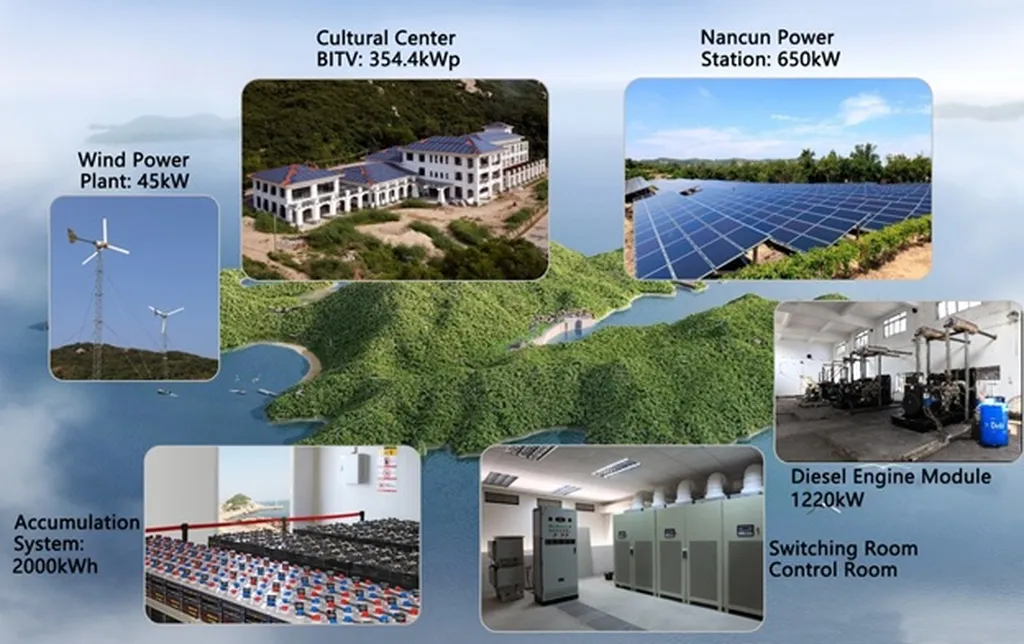
In the quest to make campus microgrids more efficient and cost-effective, a team of researchers from China Three Gorges University and the Changjiang Institute of Survey, Planning, Design and Research Co., Ltd. has developed a groundbreaking strategy that could revolutionize how these energy systems operate. Led by Dr. Huashen He, the team’s work, published in *Dianli jianshe* (which translates to *Electric Power Construction*), addresses the persistent challenges of high operational costs and power exchange fluctuations in campus microgrids.
The researchers propose a multi-timescale coordinated scheduling strategy that integrates micro-turbines (MTs) and air-conditioning building clusters, taking into account the uncertainties of grid curtailment. This innovative approach not only mitigates power fluctuations but also significantly reduces system costs. “Our strategy dynamically coordinates power allocation between the micro-turbine and virtual energy storage, adapting seamlessly to power fluctuations,” explains Dr. He. “This adaptability is crucial for both grid-connected and islanded modes of operation.”
The team’s method involves creating a virtual energy storage model for air-conditioned buildings by analyzing the flexible energy characteristics of variable-frequency air conditioners. By combining this with the power generation and energy consumption dynamics of MTs, they developed a short-timescale efficiency-coordinated control method. This method allows the system to adaptively mitigate power fluctuations, ensuring a more stable and efficient energy supply.
One of the most compelling aspects of this research is its potential to enhance the economic performance of microgrid systems. Simulation results showed a remarkable reduction in total system costs—10.1% in grid-connected mode and 5.0% in islanded mode. This cost-saving potential is a game-changer for the energy sector, particularly for institutions and businesses operating microgrids.
Dr. He and his team also implemented robust optimization methods with stochastic scenario exploration to characterize uncertainties in grid curtailment, renewable generation, and load demand. This comprehensive approach ensures that the system can handle a wide range of variables, making it more reliable and resilient.
The implications of this research are far-reaching. By improving the economics of microgrid systems and providing an efficient scheduling solution for high-penetration renewable energy integration, this strategy could pave the way for more sustainable and cost-effective energy solutions. “Our goal is to design a flexible multi-timescale scheduling strategy that can adapt to different operational scenarios,” says Dr. He. “This not only enhances the reliability of the system but also mitigates the risks of systemic collapse.”
As the energy sector continues to evolve, the need for innovative solutions that balance cost, efficiency, and reliability becomes increasingly critical. This research offers a promising path forward, demonstrating how coordinated scheduling of micro-turbines and air-conditioning clusters can transform the way microgrids operate. With its potential to reduce costs and improve system performance, this strategy could well become a cornerstone of future energy management practices.