
In the quest to stabilize soft soils for construction, a groundbreaking study has shed light on the intricate dance between drilling tools and the earth itself. Zizhou Xue, a researcher at China Jingye Engineering Co., Ltd., Central Research Institute of Building and Construction Co., Ltd., in Beijing, has unveiled a novel contra-rotational shear deep soil mixing (CS-DSM) drilling tool and its interaction with soil, a discovery that could revolutionize the energy sector’s approach to foundation work.
Deep soil mixing piles are crucial for stabilizing soft soils, but until now, the internal mechanisms of how drilling tools achieve complete soil-cement homogenization have remained a mystery. This lack of understanding has hindered precise quality control in column formation, a critical aspect for energy infrastructure projects. Xue’s research, published in *Frontiers in Built Environment* (which translates to *Frontiers in the Built Environment*), aims to change that.
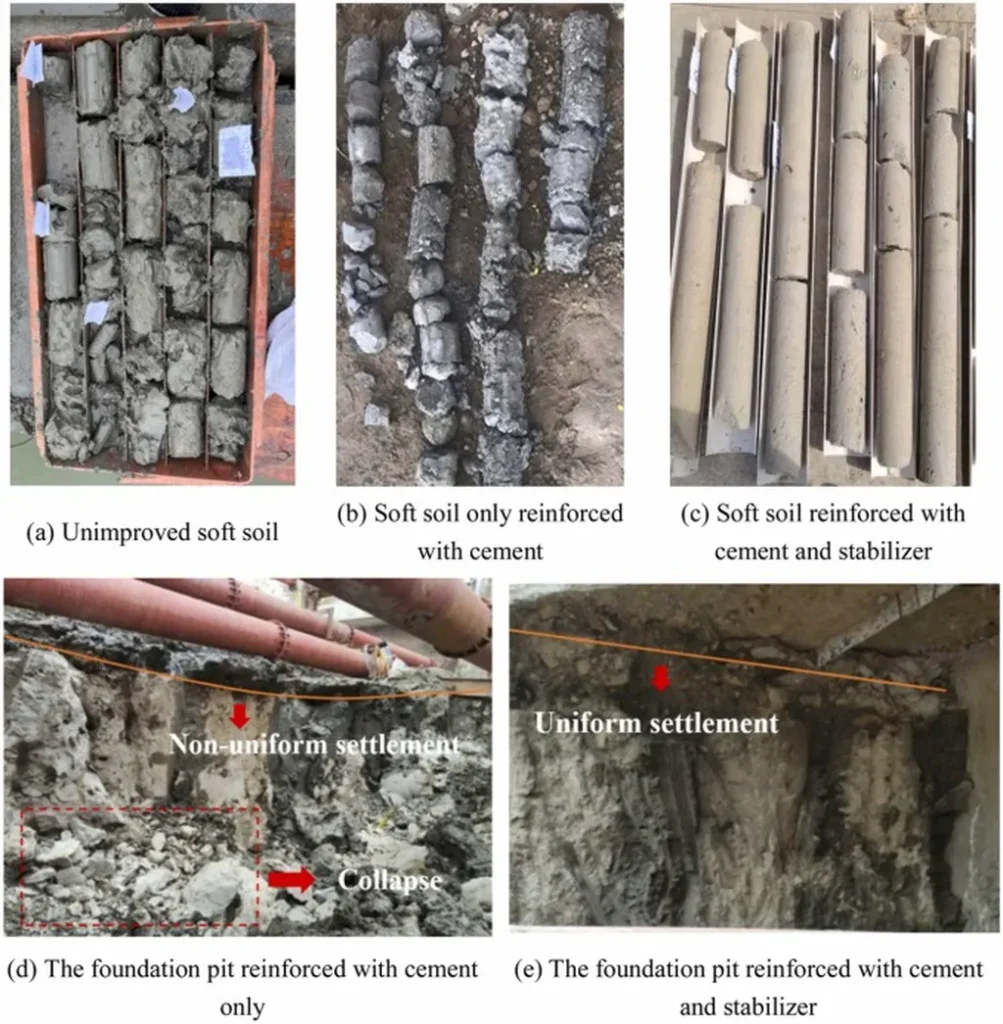
Using discrete element modeling, Xue and his team created a coupling model of the CS-DSM drilling tool and soil, verified through laboratory experiments. “We found that soil particles could be fully sheared, stirred, and mixed in both horizontal and vertical directions to form a uniform soil cement column,” Xue explained. This finding is a significant step forward in understanding the mixing dynamics during drilling.
The study revealed that soil particles along the x-axis and y-axis exhibited distinct moving patterns, with particles along the x-axis showing 1.9 times larger vertical displacement than those along the y-axis. Moreover, the mixing efficiency during drilling-down was found to be vastly different from that during drilling-up. “The vertical displacement during the drilling-down process could be 146.7 times larger than that during the drilling-up process,” Xue noted. This insight suggests that adjusting drilling speed or rotational velocity during the drilling-down phase could enhance the quality of CS-DSM piles under identical conditions.
The implications for the energy sector are profound. As energy companies increasingly venture into challenging terrains with soft soils, the ability to precisely control the quality of deep soil mixing piles becomes paramount. Xue’s research provides a scientific basis for optimizing drilling parameters, potentially leading to more stable and cost-effective foundations for energy infrastructure.
“This research is a game-changer,” said an industry expert who reviewed the study. “It offers a deeper understanding of the soil mixing process, which can lead to more efficient and reliable foundation solutions for the energy sector.”
As the energy industry continues to expand into complex environments, innovations like the CS-DSM drilling tool and the insights derived from Xue’s research will be instrumental in overcoming geological challenges. The study not only advances our scientific understanding but also paves the way for more robust and economical construction practices in the energy sector.