
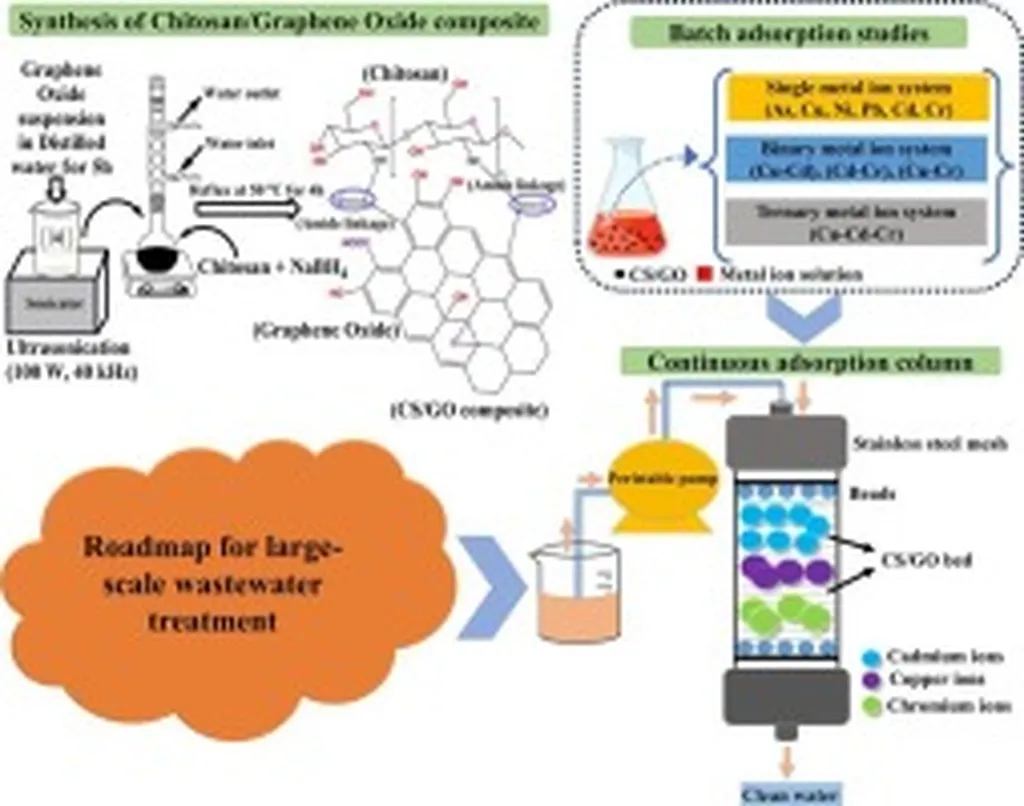
In the quest for sustainable solutions to environmental challenges, a team of researchers has developed a novel adsorbent material that could revolutionize wastewater treatment, particularly in the energy sector. The lead author, Narayanapura Mahadevappa Tanuja, has spearheaded this innovative work, which combines chitosan, a polysaccharide derived from crustacean shells, with graphene oxide and molybdenum disulfide nanoparticles to create a highly effective adsorbent for heavy metals like copper and chromium.
The research, published in the journal *eXPRESS Polymer Letters* (which translates to *Polymer Letters* in English), details the development of a multifunctional composite material that shows promising results in removing toxic ions from wastewater. The material’s unique structure, achieved through a series of chemical modifications, allows it to efficiently adsorb copper (Cu(II)) and chromium (Cr(VI)) ions from dilute solutions.
“Our goal was to create a sustainable and effective adsorbent that could address the pressing issue of heavy metal contamination in wastewater,” said Tanuja. “The results have been very encouraging, with the material demonstrating high adsorption capacities and the ability to be reused multiple times.”
The adsorbent material was characterized using various analytical techniques, including Fourier transform infrared spectroscopy (FTIR), thermogravimetric analysis (TGA), X-ray diffraction (XRD), and scanning electron microscopy (SEM). These analyses confirmed the successful incorporation of molybdenum disulfide nanoparticles and the structural modifications of chitosan.
In adsorption studies, the material showed a maximum uptake of 66.66 mg/g for copper ions and 76.92 mg/g for chromium ions. The adsorption process followed pseudo-second-order kinetics and fitted well with the Langmuir isotherm model, indicating a homogeneous adsorption process. Desorption studies further demonstrated the material’s reusability, a crucial factor for commercial applications.
From a commercial perspective, this research holds significant potential for the energy sector, particularly in industries such as mining, metallurgy, and energy production, where heavy metal contamination is a common challenge. The development of an efficient and reusable adsorbent could lead to more sustainable and cost-effective wastewater treatment solutions.
“The energy sector is increasingly focused on sustainability and environmental responsibility,” said an industry expert familiar with the research. “Innovations like this adsorbent material can play a crucial role in reducing the environmental impact of industrial processes and ensuring compliance with regulatory standards.”
The thermodynamic studies conducted as part of the research indicated that the adsorption process is spontaneous and endothermic, providing further insights into the material’s adsorption mechanisms. These findings highlight the material’s potential as an effective and sustainable approach for environmental remediation.
As the energy sector continues to evolve, the demand for innovative solutions to environmental challenges will only grow. This research by Tanuja and their team represents a significant step forward in the development of sustainable adsorbent materials, offering a glimpse into the future of wastewater treatment and environmental remediation. The work published in *eXPRESS Polymer Letters* not only advances scientific knowledge but also paves the way for practical applications that can benefit industries and the environment alike.