
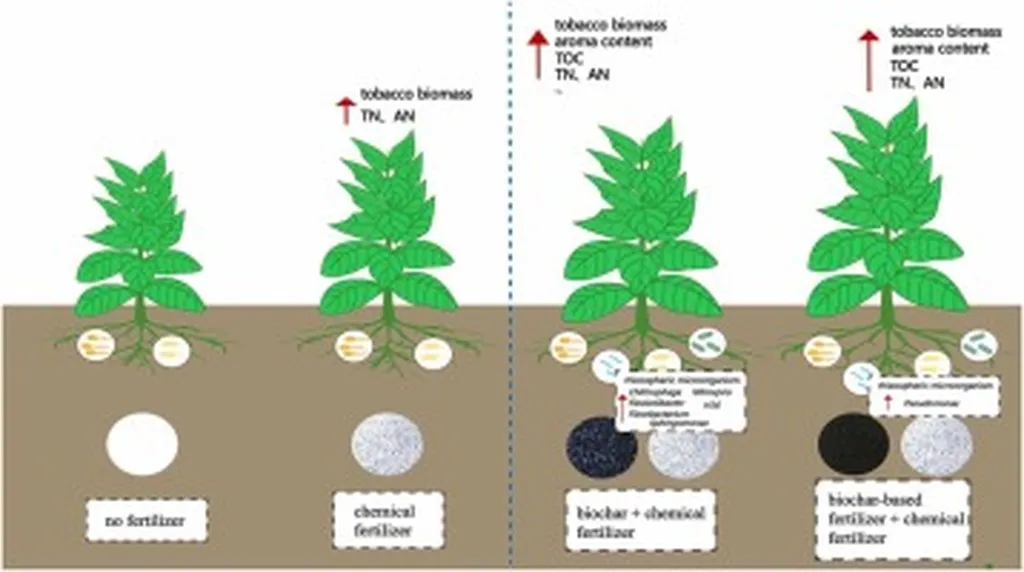
In the heart of China’s agricultural landscape, a groundbreaking study is reshaping our understanding of soil health and tobacco productivity. For seven years, researchers led by Wei Yang from the Institute of Environment and Sustainable Development in Agriculture at the Chinese Academy of Agricultural Sciences, have been meticulously comparing the long-term impacts of different organic fertilizers on soil and tobacco crops. The findings, recently published in the journal *Frontiers in Soil Science* (translated as “土壤科学前沿”), are nothing short of transformative.
The study, which delved into the effects of chemical fertilizer (CF), manure (CM), straw mulching (SM), and farmyard compost of manure and straw (FM) on soil health and tobacco productivity, has revealed some compelling insights. “We found that the soil quality index under CM, SM, and FM treatments was significantly higher than that of the CF treatment,” explains Wei Yang. This is a crucial finding, as soil quality is the bedrock of agricultural productivity.
The research showed that CM, SM, and FM treatments increased the soil ecosystem multifunctionality (EMF) by 86.3%, 80.0%, and 106.7%, respectively. This means that soils treated with these organic amendments are not only healthier but also more resilient and productive. Moreover, the microbial diversity index, a key indicator of soil health, was also higher in these treatments.
But the benefits don’t stop at the soil. The study also found that CM, SM, and FM treatments increased tobacco yield by 6.5%, 2.8%, and 12.9%, respectively. Even more impressive, the proportion of premium-grade leaves, which fetch higher prices in the market, was significantly enhanced by 17.8%, 3.2%, and 28.5%, respectively.
So, what does this mean for the agricultural industry? For starters, it’s a wake-up call to move away from chemical fertilizers and embrace organic amendments. “Farmyard compost of manure and straw maximized the concurrent gains in soil health and tobacco yield and quality,” says Wei Yang. This could be a game-changer for tobacco farmers, who can now look forward to higher yields and better quality, translating to better profits.
The study also has implications for the energy sector, particularly in the production of bioenergy. Healthier soils and higher yields mean more biomass available for bioenergy production. This could contribute to a more sustainable and renewable energy future.
The research is a significant step forward in our understanding of soil health and its impact on crop productivity. It’s a testament to the power of long-term, systematic research and a call to action for farmers and policymakers alike. As we grapple with the challenges of climate change and food security, studies like this one provide valuable insights and practical solutions.
In the words of Wei Yang, “This study underscores the importance of adopting sustainable agricultural practices that not only enhance productivity but also safeguard our soils for future generations.” It’s a message that resonates now more than ever.