
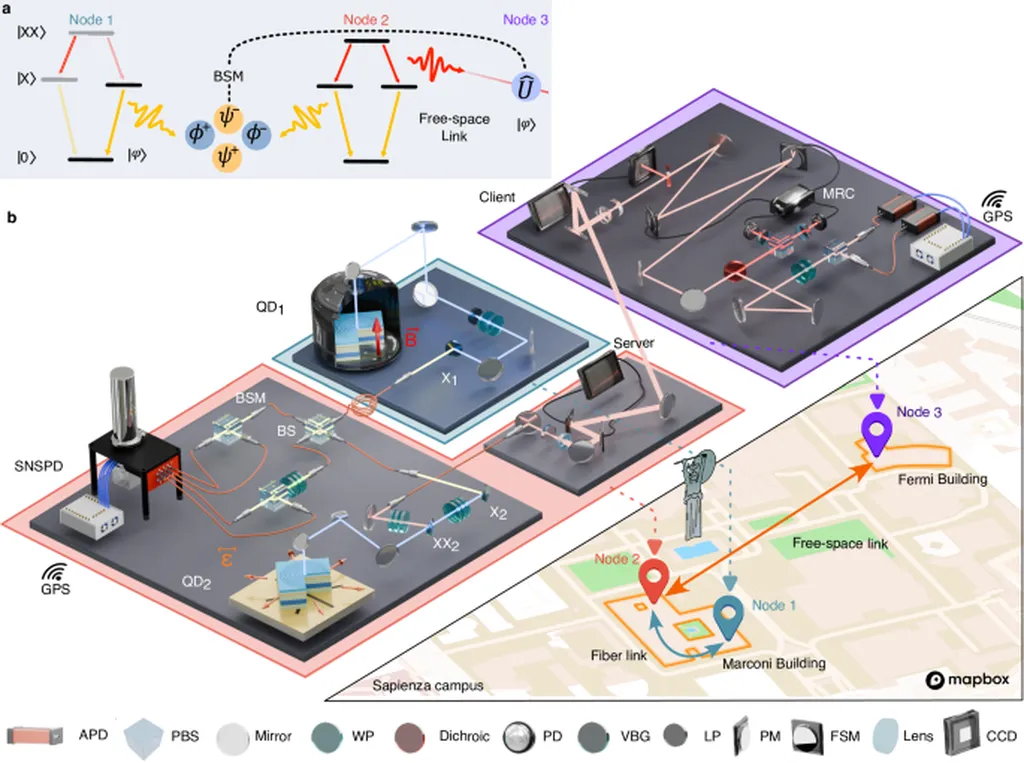
In the rapidly evolving landscape of quantum communication, researchers are laying the groundwork for a future where secure, high-speed data transfer is not just a pipe dream but a reality. At the heart of this revolution is the concept of quantum entanglement, a phenomenon that Einstein famously referred to as “spooky action at a distance.” This entanglement is the cornerstone of quantum networks, enabling secure communication and enhanced computational capabilities. However, the practical implementation of these networks faces significant challenges, primarily due to the susceptibility of entanglement to noise and the limited range of current quantum networks.
Enter Benedikt Baier, a researcher at the Technical University of Munich, who, along with his team, has developed new models and protocols to simulate and improve entanglement generation in quantum networks. Their work, published in the IEEE Transactions on Quantum Engineering (translated to English as “IEEE Transactions on Quantum Engineering”), is a significant step forward in the quest to make quantum networks a practical reality.
The team’s research focuses on two critical aspects: the physical layer, which deals with the actual generation of entanglement, and the link layer, which manages the communication protocols. “We developed two new models for entanglement generation and quantum protocols for generating and purifying entanglement,” Baier explains. “These protocols were then evaluated under both perfect and realistic conditions regarding delay and fidelity.”
The results of their simulations are promising. The models proved to be accurate, with the delay primarily influenced by the source duration. Moreover, longer coherence times significantly enhanced fidelity. “The model runtimes were consistently shorter than the simulation runtimes across all protocols, averaging about 2% of the total simulation time,” Baier adds.
So, what does this mean for the future of quantum communication and the energy sector? Quantum networks have the potential to revolutionize secure communication, which is crucial for the energy sector where data integrity is paramount. Imagine a future where power grids are managed by quantum computers, capable of processing vast amounts of data in real-time, optimizing energy distribution, and preventing outages. This is not just science fiction; it’s a future that researchers like Baier are working towards.
The energy sector stands to gain significantly from advancements in quantum communication. Secure, high-speed data transfer can enhance grid management, improve cybersecurity, and enable more efficient energy distribution. As quantum networks become more robust and widespread, we can expect to see a ripple effect across various industries, with the energy sector at the forefront.
Baier’s research is a testament to the power of innovation and the potential of quantum networks. As we stand on the brink of a quantum revolution, it’s clear that the work being done today will shape the technologies of tomorrow. The journey is just beginning, and the possibilities are endless.