
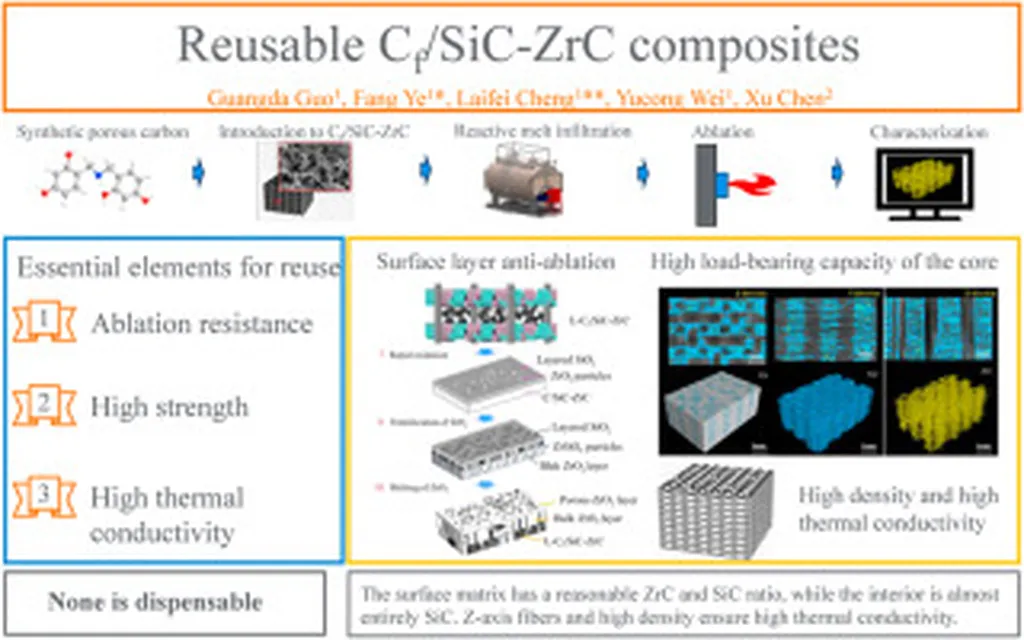
In the relentless pursuit of materials that can withstand the harshest environments, researchers have turned their attention to zirconium diboride-silicon carbide (ZrB2-SiC) composites, already renowned for their high melting points and exceptional properties. A recent study, led by Mohsen Ghasilzade Jarvand from the Department of Materials Science and Engineering at Ahvaz Islamic Azad University in Iran, has delved into the impact of adding zirconium carbide (ZrC) to these composites, with intriguing results that could reshape the energy sector.
The research, published in the *Journal of Advanced Materials in Engineering* (translated from Persian as “Journal of Advanced Materials in Engineering”), focused on the oxidation resistance of ZrB2-SiC composites at an astonishing 1400°C. The team sintered three composites containing varying amounts of ZrC—4, 8, and 12 vol.%—using the spark plasma sintering (SPS) method. The samples were then subjected to oxidation tests in a box furnace, with weight changes meticulously recorded to evaluate their resistance to oxidation.
The findings were surprising. “We found that the presence of zirconium carbide actually decreases the oxidation resistance of the composite,” Ghasilzade Jarvand explained. This discovery challenges previous assumptions and opens new avenues for research. The study also revealed that the oxidation mechanism of the composites was controlled by diffusion, following a parabolic trend. This insight is crucial for understanding how these materials behave under extreme conditions.
The implications for the energy sector are significant. ZrB2-SiC composites are already used in aerospace and aviation industries due to their high melting points and robustness. However, their susceptibility to oxidation at high temperatures has been a persistent challenge. This research suggests that while ZrC may not be the solution for enhancing oxidation resistance, it provides a deeper understanding of the oxidation mechanisms at play. This knowledge could pave the way for developing new materials or treatments that can better withstand the rigors of high-temperature environments.
As the energy sector continues to push the boundaries of what’s possible, materials like ZrB2-SiC composites will play a pivotal role. The findings from this study not only shed light on the limitations of current materials but also offer a roadmap for future innovations. “The rate of oxygen diffusion is the key parameter in the oxidation of this composite during the oxidation process,” Ghasilzade Jarvand noted. This understanding could lead to the development of more resilient materials, ultimately enhancing the efficiency and safety of energy systems.
In a field where every degree of improvement counts, this research marks a significant step forward. As the energy sector strives to meet the demands of a rapidly changing world, the insights gained from this study will be invaluable. The journey to discovering materials that can withstand the harshest conditions is far from over, but with each new discovery, we edge closer to a future where energy is not just powerful but also sustainable and reliable.