
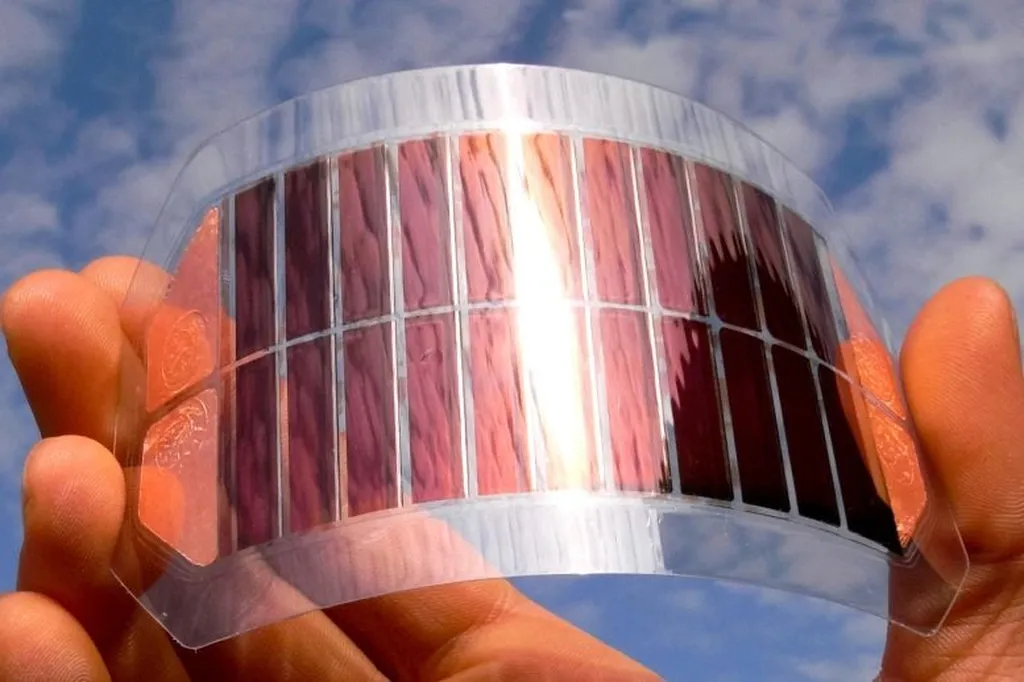
In the quest for sustainable energy solutions, organic photovoltaic (PV) devices have emerged as a beacon of hope, offering a lightweight, flexible, and cost-effective alternative to traditional solar panels. Now, a groundbreaking study led by Nam V. Nguyen from the Industrial University of Ho Chi Minh City has delved into the nonlinear free vibration characteristics of ultra-thin organic solar plates, potentially revolutionizing their design and optimization.
The research, published in the Vietnam Journal of Mechanics (known in English as the “Journal of Mechanics of Vietnam”), introduces an advanced computational approach to analyze the dynamic behavior of these innovative solar panels. By modeling the solar panel structure as a multilayered plate, Nguyen and his team employed a refined higher-order shear deformation theory combined with the von Kármán nonlinear strain assumption. This sophisticated method enables the capture of large-amplitude effects, providing a comprehensive understanding of the panels’ nonlinear natural frequencies.
“Our study aims to bridge the gap between theoretical modeling and practical engineering applications,” says Nguyen. “By investigating the nonlinear vibration characteristics, we can offer valuable insights into the structural integrity and performance of ultra-thin organic solar plates.”
The research employed non-uniform rational B-splines (NURBS)-based isogeometric analysis (IGA) in conjunction with an iterative displacement-control scheme. This cutting-edge approach allowed the team to validate the accuracy and robustness of their formulation through several benchmark investigations. Moreover, they explored the impact of key factors such as boundary conditions, length-to-thickness ratios, and aspect dimensions on the nonlinear vibration characteristics.
The findings of this study hold significant implications for the energy sector. By understanding the dynamic behavior of ultra-thin organic solar plates, engineers can optimize their design to enhance durability and efficiency. This, in turn, can accelerate the adoption of organic PV devices in various applications, from flexible solar panels for wearable technology to lightweight solar arrays for space exploration.
“Our research is a stepping stone towards the widespread commercialization of organic photovoltaic devices,” Nguyen explains. “By providing a robust computational framework, we hope to inspire further innovations in the field and contribute to a sustainable energy future.”
As the world continues to grapple with the challenges of climate change and energy security, the insights gained from this study could pave the way for more efficient and reliable solar energy solutions. By pushing the boundaries of theoretical modeling and practical engineering, Nguyen and his team are lighting the way towards a brighter, more sustainable future.