
In the realm of advanced materials and sensing technologies, a groundbreaking development has emerged from the labs of Imam Mohammad Ibn Saud Islamic University (IMSIU) in Riyadh, Saudi Arabia. Dr. Mohamad A. Alawad, a leading researcher in the Department of Electrical Engineering, has introduced a novel metamaterial absorber that promises to revolutionize sensing applications across various industries, including the energy sector. This innovation, detailed in a recent study published in the *International Journal of Optomechatronics* (translated as the Journal of Light and Precision Engineering), could significantly enhance the precision and efficiency of electromagnetic wave manipulation in sensing technologies.
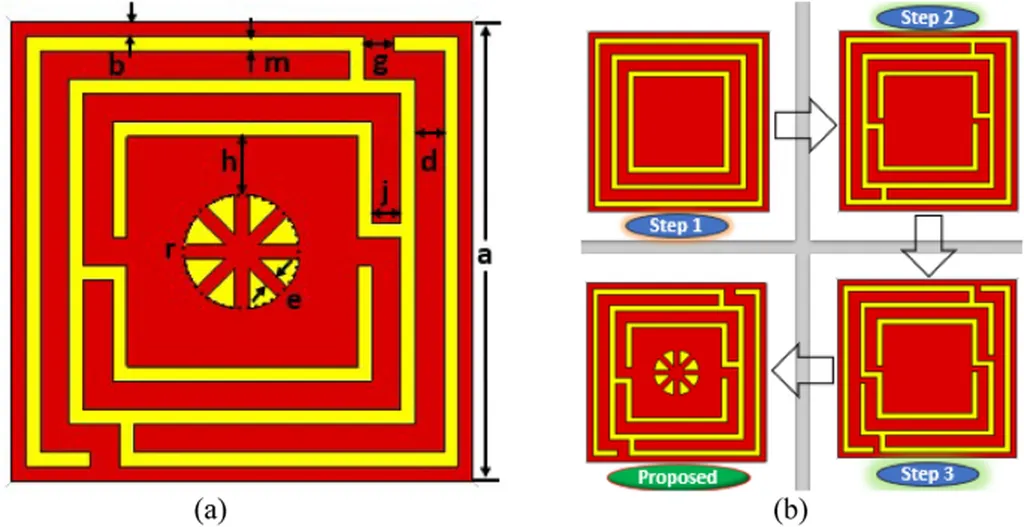
The research focuses on a dual-band circular split-ring resonator (CSRR)-based metamaterial absorber (MTMA), designed to achieve near-perfect absorption rates at two distinct frequencies: 10.48 GHz (X-band) and 14.57 GHz (Ku-band). These frequencies are crucial for a wide range of sensing applications, from biomedical diagnostics to industrial quality control. The absorber’s design, fabricated on a Rogers RT 5880 substrate with copper layers, was optimized through CST Microwave Studio simulations, ensuring high performance and reliability.
“The key innovation here is the triple-stage design refinement of the metamaterial absorber,” explains Dr. Alawad. “This refinement enhances the resonance characteristics, allowing for precise detection of dielectric variations in both solid and liquid materials. The result is a sensor that can measure frequency shifts with remarkable accuracy, making it highly sensitive to changes in the environment.”
The experimental validation of the MTMA confirmed its robust performance, with a sensitivity of up to 2.51 GHz/εᵣ and quality factors reaching 189. These metrics outperform existing single-band metamaterial sensors, positioning the dual-band CSRR-based MTMA as a superior solution for high-sensitivity sensing applications. The absorber’s compact size and consistent response under varying permittivity’s make it particularly suitable for applications in the energy sector, where precise monitoring of fuel quality and adulteration detection are critical.
“The potential commercial impacts of this technology are vast,” notes Dr. Alawad. “In the energy sector, for instance, our metamaterial absorber can be used to detect fuel adulteration with unprecedented accuracy. This not only ensures the integrity of fuel supplies but also enhances safety and efficiency in industrial processes.”
Beyond the energy sector, the applications of this technology extend to biomedical diagnostics, where precise sensing of biological materials can lead to earlier and more accurate diagnoses. The absorber’s ability to detect dielectric variations in liquids also makes it ideal for environmental monitoring, ensuring the quality of water and other natural resources.
The study, published in the *International Journal of Optomechatronics*, represents a significant step forward in the field of metamaterial-based sensing technology. By bridging the gap between simulation and real-world implementation, Dr. Alawad’s research offers a scalable and efficient solution for electromagnetic wave manipulation in next-generation sensor systems.
As the world continues to demand more sophisticated and reliable sensing technologies, innovations like the dual-band CSRR-based metamaterial absorber are poised to shape the future of various industries. The research not only advances the scientific understanding of metamaterials but also paves the way for practical applications that can transform the way we monitor and control our environment.