
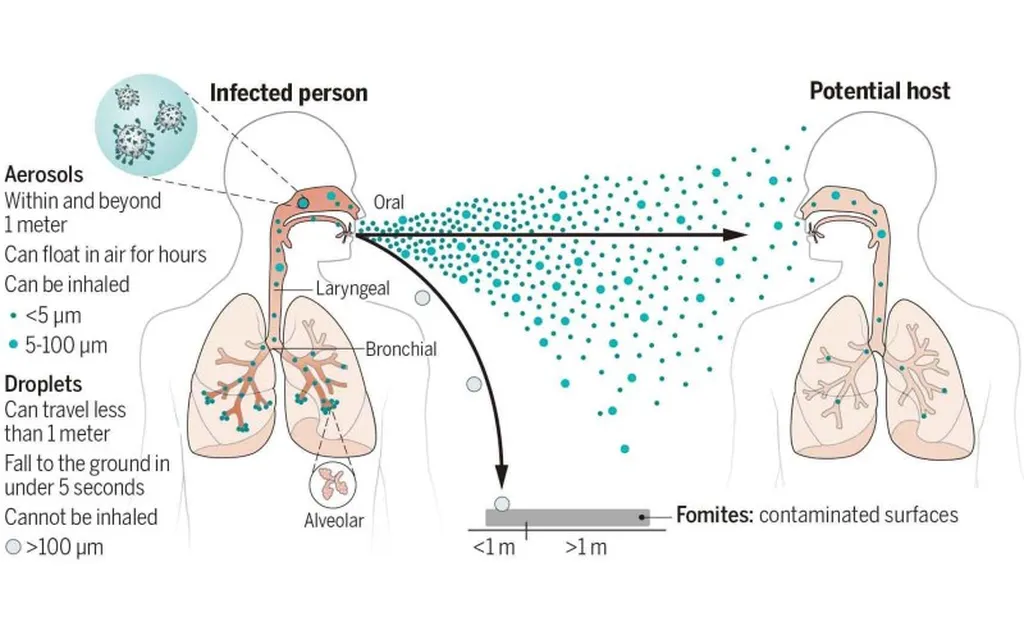
In the ongoing battle against COVID-19, ventilation has been a key strategy to curb the virus’s spread. However, new research published in the journal *Indoor Environments* (translated to English as “Indoor Air Environments”) suggests that increasing ventilation rates in certain settings might not always be the best approach. The study, led by Timothy Foat from the Defence Science and Technology Laboratory (Dstl) in Porton Down, UK, used computational fluid dynamics to simulate exposure to SARS-CoV-2 in a room with mixing ventilation.
The findings challenge some conventional wisdom about ventilation. “We found that up to 3 meters from the infected person, the median exposure to the virus increased significantly as the ventilation rate was increased,” Foat explained. For instance, when the room’s air change rate was boosted from 0.5 to 5 air changes per hour, the median exposure after 5 minutes increased by a factor of 7 or even 134, depending on the model settings. This counterintuitive result highlights the complex interplay between ventilation rates and virus transmission.
The study’s models showed that the negative impact of mixing ventilation on exposure reduced over time, aligning with general guidance that emphasizes ventilation’s benefits in spaces where people spend extended periods. This nuanced understanding could have significant implications for the energy sector, particularly in commercial buildings where ventilation systems are a major energy consumer.
“Our findings suggest that a one-size-fits-all approach to ventilation may not be the most effective strategy,” Foat noted. Instead, the research points to the need for tailored ventilation solutions that consider the specific context and usage patterns of a space. This could lead to more energy-efficient ventilation systems that balance the need for air quality with the demand for energy conservation.
The study also underscores the importance of computational fluid dynamics in understanding and mitigating virus transmission. As Foat put it, “This technology allows us to simulate and visualize the spread of aerosols in ways that were previously impossible. It’s a powerful tool for informing public health strategies.”
The research published in *Indoor Environments* could shape future developments in ventilation technology and energy management. By providing a more nuanced understanding of how ventilation rates affect virus transmission, it paves the way for more sophisticated and energy-efficient solutions. As the world continues to grapple with COVID-19 and prepares for future pandemics, such insights will be invaluable in creating safer and more sustainable indoor environments.