
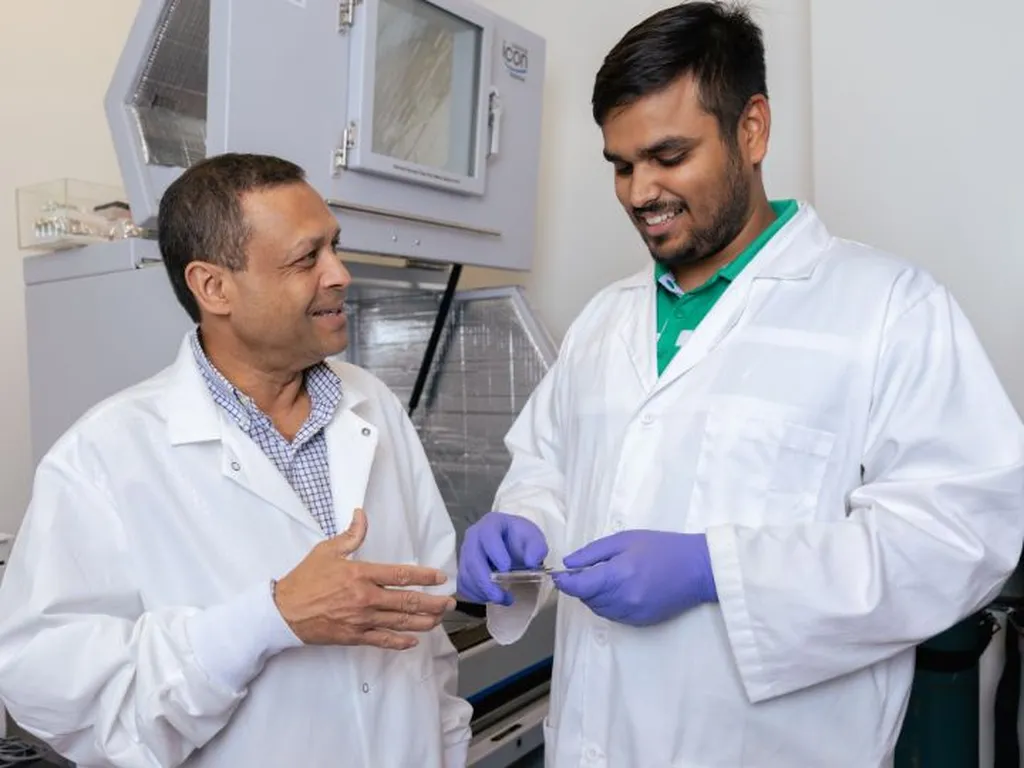
In the heart of Algeria, at the University Ferhat ABBAS in Setif, a team of researchers led by A. Kharmouche from the Department of Physics has been delving into the fascinating world of thin films, with potential implications for the energy sector. Their recent study, published in *Discover Materials* (translated from French), explores the growth, structure, and surface properties of Fe1−xPdx thin films, offering insights that could drive future advancements in magnetic storage and energy technologies.
The research focuses on a series of Fe1−xPdx thin films, each 100 nanometers thick, deposited onto silicon substrates using thermal evaporation under vacuum. The team varied the composition of iron (Fe) and palladium (Pd) in these films, with Pd content ranging from 16 to 36 atomic percent. Using Energy Dispersive X-Ray Spectroscopy (EDX), they quantified the composition of the thin films, while X-ray diffraction (XRD) revealed the structural properties.
One of the most intriguing findings was the decrease in crystallite size from 18.2 to 9.5 nanometers as the Pd content increased. “This reduction in crystallite size is significant,” explains Kharmouche, “as it directly impacts the magnetic and mechanical properties of the thin films, which are crucial for applications in data storage and energy devices.”
The study also observed that the lattice parameter of the thin films was greater than the bulk value and increased with Pd content, in accordance with Vegard’s law. This indicates that the thin films were under tensile stress, a factor that could influence their performance in practical applications.
Surface topography and roughness were examined using Atomic Force Microscopy (AFM), with root-mean square (RMS) roughness values ranging from 0.8 to 2.2 nanometers. Most of the films were found to be smooth, a desirable trait for many technological applications.
The implications of this research are far-reaching. In the energy sector, thin films with tailored magnetic and mechanical properties could lead to more efficient and compact energy storage solutions. For instance, these films could be used in magnetic storage devices, where high-density data storage is crucial. Additionally, the understanding of stress and strain in thin films could pave the way for more robust and reliable energy conversion devices.
As Kharmouche notes, “Our findings provide a foundation for further research into the optimization of thin film properties for specific applications. By fine-tuning the composition and structure of these films, we can potentially enhance their performance in various energy-related technologies.”
This study not only advances our understanding of FePd thin films but also opens up new avenues for innovation in the energy sector. As the world continues to seek sustainable and efficient energy solutions, research like this is pivotal in driving technological progress. Published in *Discover Materials*, this work underscores the importance of fundamental research in shaping the future of energy technologies.