
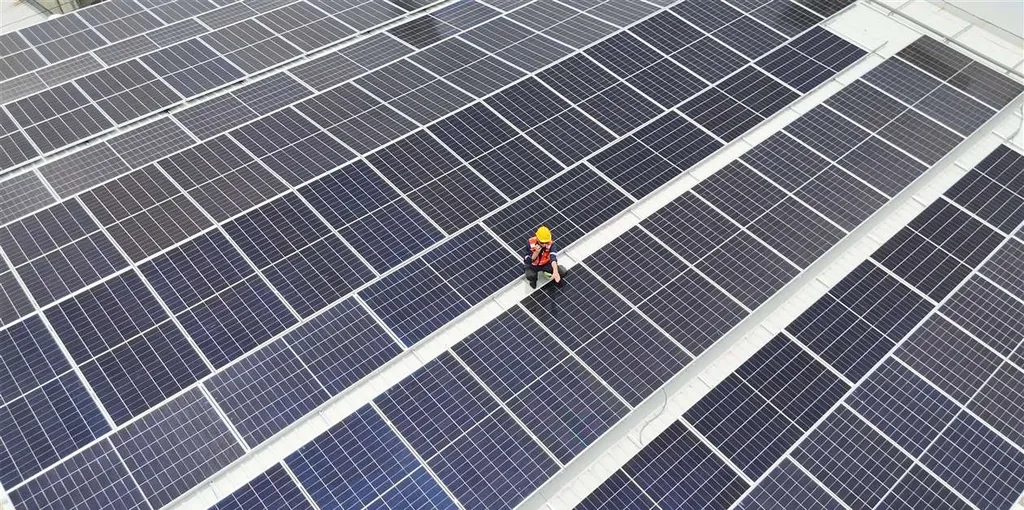
In a significant stride towards sustainable energy access, researchers have demonstrated the viability of rooftop photovoltaic (PV) systems in public sector buildings across diverse climates. The study, led by Salman Habib from the Department of Control & Instrumentation Engineering at King Fahd University of Petroleum & Minerals, was recently published in *Scientific Reports* (translated from Arabic as *Scientific Reports*).
The research presents a comprehensive technical evaluation of grid-connected rooftop solar PV systems installed at two public sector buildings located in climatically diverse regions. The primary goal was to maximize the energy output of each PV system, designed and optimized based on local conditions and resource availability.
At the first proposed location (PL-1), situated in a semi-arid region, a 417.96 kWp system was installed, estimated to generate around 594.743 MWh of energy annually. This offsets 95.52% of the building’s annual energy consumption with a performance ratio (PR) of 82.6%. The second location (PL-2), in a hilly region, features a 63.2 kWp system projected to produce 93.76 MWh, with a predicted PR of 80.1%.
“These systems not only reduce energy costs but also significantly cut carbon emissions,” Habib explained. “Under a degradation rate of 1%, the anticipated lifetime energy output is 13.214 GWh and 2.081 GWh, respectively. Environmental impact research indicates that each system achieves a carbon payback time of just 42 days, with cumulative CO₂ offsets of approximately 6606.96 metric tons (PL-1) and 1040.367 metric tons (PL-2) throughout their operational lifespan.”
The economic evaluations show that PV systems installed at PL-1 and PL-2 have Levelized Cost of Energy (LCOE) of 9.54 PKR/kWh and 9.37 PKR/kWh and payback periods of around 3.27 and 3.39 years, respectively. “This confirms their long-term economic sustainability,” Habib added.
The study underscores the importance of tailored modeling, solar resource assessment in specific locations, and a net metering policy for optimal renewable energy integration within the national energy policy framework. The findings validate that the implementation of rooftop photovoltaic systems in public sector buildings is both technically and economically feasible.
This research could shape future developments in the energy sector by providing a blueprint for integrating renewable energy systems in diverse climates. It highlights the potential for significant cost savings and environmental benefits, making a compelling case for wider adoption of rooftop PV systems in public and private sectors alike. As the world moves towards smarter grids and sustainable cities, this study offers valuable insights into the practical implementation of renewable energy solutions.