
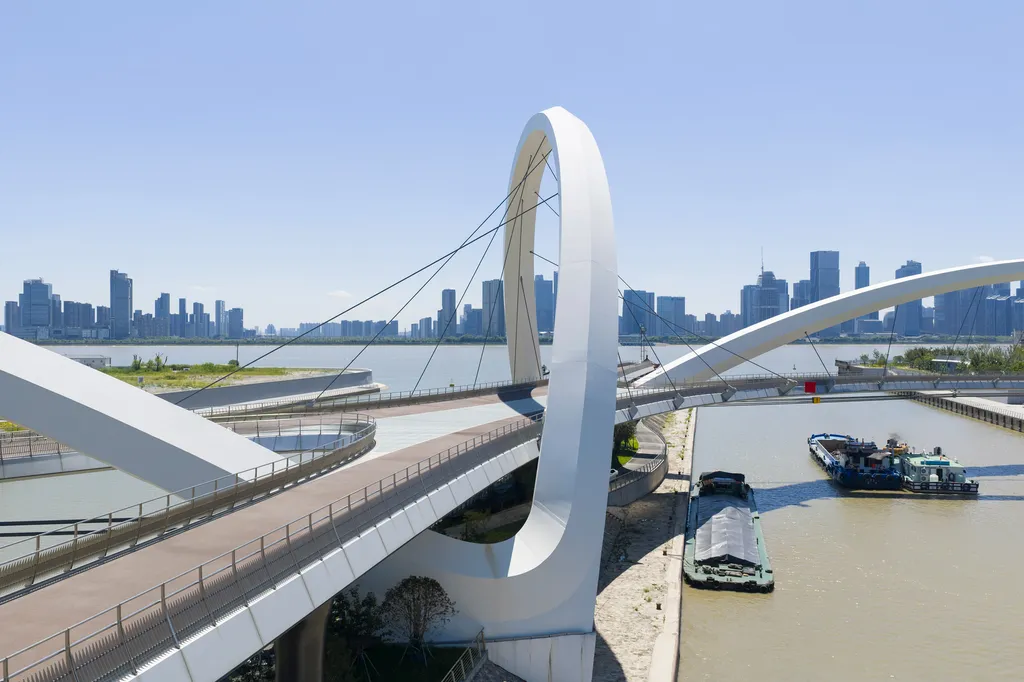
In the world of bridge construction, innovation is the key to overcoming the challenges posed by increasingly ambitious designs. A recent study published in the *Baltic Journal of Road and Bridge Engineering* (translated from Lithuanian as “The Baltic Journal of Road and Bridge Engineering”) by Tao Wang of the Highway Institute at Henan College of Transportation in Zhengzhou, China, sheds light on a critical aspect of constructing stiff skeleton arch bridges: out-of-plane buckling during the concrete encasement process.
The study focuses on the stability of these bridges during the crucial phase when concrete is wrapped around the skeleton structure. Using advanced nonlinear finite element analysis, Wang and his team investigated the behavior of a 600-meter span stiff skeleton arch bridge. Their findings reveal that the lateral deflection angle of arch ribs is a pivotal metric for assessing the out-of-plane stability of such bridges.
One of the most significant revelations from the research is the role of transverse braces in enhancing the stability of arch ribs. “Transverse braces effectively coordinate and constrain the lateral deflections of two isolated arch ribs through their bending stiffness along the tangential direction of the arch axis,” Wang explains. The study found that transverse braces within the range of L/8 to 3L/8 contribute most substantially to the lateral stiffness of arch ribs.
This research has profound implications for the construction industry, particularly for projects involving long-span arch bridges. By understanding the mechanisms behind out-of-plane buckling and the role of transverse braces, engineers can implement more effective stability-enhancing methods. Wang proposes a method for improving stability by controlling the lateral rotation angle of arch ribs, which could lead to more efficient and safer construction processes.
The commercial impact of this research is substantial. For the energy sector, which often requires the construction of large-scale infrastructure, the ability to build more stable and efficient bridges can lead to significant cost savings and improved project timelines. “Wrapping surrounding concrete on transverse braces within the L/8 to 3L/8 range proves advantageous for enhancing the stability of a stiff skeleton arch bridge under construction,” Wang notes. This insight could revolutionize the way engineers approach the construction of similar structures, ensuring better stability and longevity.
As the construction industry continues to evolve, research like Wang’s is crucial for driving innovation and improving safety standards. The findings published in the *Baltic Journal of Road and Bridge Engineering* provide a valuable resource for engineers and researchers, offering new insights into the stability of stiff skeleton arch bridges and paving the way for future advancements in the field.