
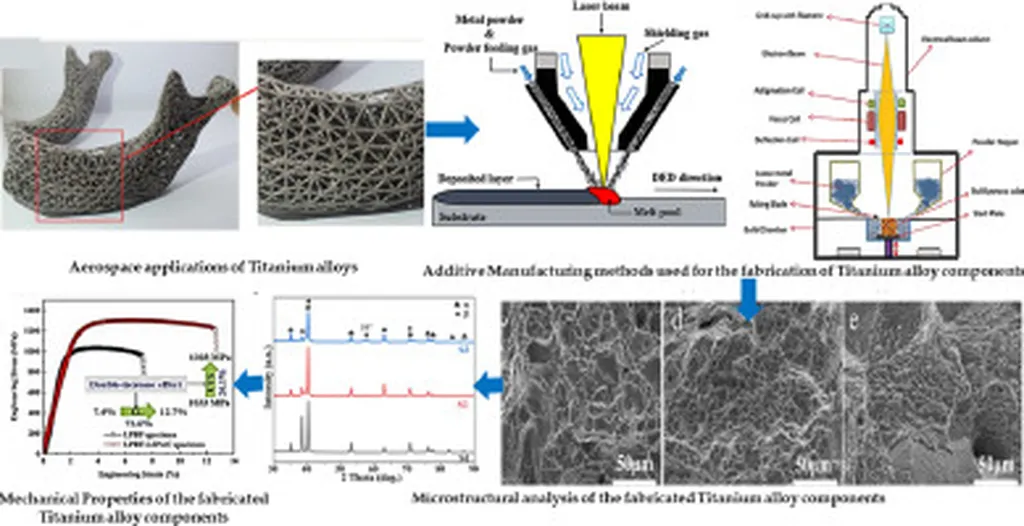
In the high-stakes world of aerospace engineering, where materials face extreme conditions, a recent study has shed light on optimizing the erosion resistance of a critical titanium alloy. Shashikumar S., from the Department of Aerospace Engineering at Jain (Deemed-to-be University) in Bangalore, India, led a comprehensive investigation into the high-temperature solid particle erosion (HTSPE) characteristics of the heat-treated Ti–6Al–5Zr–0.5Mo–0.2Si alloy. This alloy is a staple in aerospace applications due to its exceptional thermal stability and mechanical properties.
The study, published in the journal “Materials Research Express” (which translates to “Materials Research Express” in English), employed a sophisticated approach using response surface methodology (RSM) to model and analyze the erosion rate of the alloy under varying conditions. The team varied three key parameters: specimen temperature (ranging from 200 °C to 750 °C), erodent velocity (30 to 100 m/s), and impingement angle (30°, 60°, and 90°). This meticulous process aimed to identify the optimal conditions for minimizing erosion.
Shashikumar S. explained, “We used a Box-Behnken design integrated with response surface methodology to develop a predictive model for the erosion rate. The goal was to understand how these parameters interact and influence the material’s performance.”
The findings revealed that the impingement angle was the most significant factor affecting the erosion rate, followed by erodent velocity, with specimen temperature having a relatively moderate effect. The study found that the lowest erosion rate, 0.002217 mg/g, was achieved at a specimen temperature of 304 °C, an erodent velocity of 35 m/s, and an impingement angle of 60°.
Field emission scanning electron microscopy (FESEM) was used to examine the surface morphology, providing insights into the different erosion mechanisms. At a 90° impingement angle, material degradation was primarily governed by indentation and ploughing, while at a 30° angle, cutting and shear deformation were the dominant mechanisms.
This research has significant implications for the aerospace industry, particularly in designing components that can withstand high-temperature environments. By optimizing the operating conditions, engineers can enhance the erosion resistance of critical parts, leading to improved durability and reduced maintenance costs.
Shashikumar S. added, “Understanding these mechanisms is crucial for developing materials that can perform reliably in extreme conditions. Our findings provide a roadmap for optimizing the performance of titanium alloys in high-temperature applications.”
The study’s insights are not only relevant to aerospace but also to other industries where materials face similar challenges, such as energy generation and manufacturing. As the demand for more efficient and durable materials grows, research like this paves the way for innovative solutions that can withstand the harshest environments.
In the broader context, this research highlights the importance of advanced modeling techniques in material science. By leveraging tools like RSM, engineers can make data-driven decisions that enhance material performance and longevity. As Shashikumar S. noted, “The integration of advanced modeling techniques with experimental data is key to unlocking the full potential of materials in demanding applications.”
This study, published in “Materials Research Express,” serves as a testament to the power of interdisciplinary research in driving technological advancements. As the aerospace industry continues to push the boundaries of what’s possible, such insights will be invaluable in shaping the future of material science and engineering.