
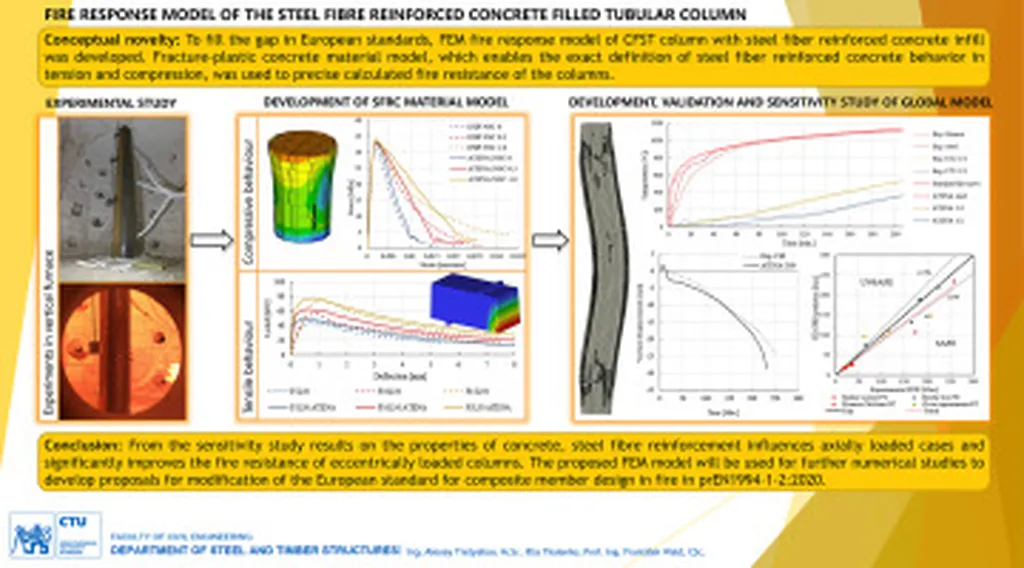
In the relentless pursuit of stronger, more durable construction materials, researchers have long turned to high-performance concrete (HPC) for its exceptional strength and durability. However, a significant challenge has loomed large: fire resistance. The very qualities that make HPC so robust—its dense structure and low porosity—can turn against it in high temperatures, leading to explosive spalling and catastrophic failure. Enter Věra Kabíčková, a researcher at the Czech Technical University in Prague, who is exploring innovative solutions to this pressing issue.
Kabíčková’s recent study, published in *Acta Polytechnica CTU Proceedings* (which translates to *Proceedings of the Czech Technical University*), delves into the potential of fiber reinforcement to bolster the fire resistance of HPC. The research compares the effectiveness of commonly used polypropylene fibers with less conventional flax and viscose fibers. The findings could have significant implications for the construction and energy sectors, particularly in applications where fire safety is paramount.
The problem at hand is stark. “High-performance concrete, due to its low porosity, creates extremely high water vapor pressure when exposed to fire,” Kabíčková explains. “This pressure can lead to explosive spalling, where pieces of concrete break off violently, compromising the structure’s integrity.” To mitigate this risk, Kabíčková and her team investigated the impact of different fibers on the concrete’s behavior under fire conditions.
The study involved subjecting fiber-reinforced HPC samples to high temperatures and then testing their mechanical properties, including compressive and flexural strength. The results were compared to reference samples that had not been exposed to fire. The findings revealed that while all three types of fibers—polypropylene, flax, and viscose—offered some level of protection, their effectiveness varied.
Polypropylene fibers, which are widely used in the industry, performed as expected, providing a reasonable level of fire resistance. However, the flax and viscose fibers showed promising results as well, suggesting that more sustainable and potentially cost-effective alternatives to polypropylene could be viable. “The use of natural fibers like flax could offer an eco-friendly solution without compromising performance,” Kabíčková notes.
The commercial implications of this research are substantial. In the energy sector, where structures often need to withstand extreme conditions, the development of fire-resistant HPC could lead to safer, more resilient infrastructure. For instance, power plants, data centers, and other critical facilities could benefit from materials that maintain their integrity even under intense heat.
Moreover, the potential for cost savings and sustainability cannot be overlooked. As Kabíčková points out, “The construction industry is always looking for ways to reduce costs and environmental impact. If we can develop effective, eco-friendly alternatives to traditional fibers, it would be a significant step forward.”
The study also opens up new avenues for future research. Kabíčková suggests that further investigation into the optimal fiber types, concentrations, and combinations could yield even better results. “There’s a lot of potential here,” she says. “We’re just scratching the surface of what’s possible with fiber-reinforced high-performance concrete.”
As the construction industry continues to evolve, the need for innovative, high-performance materials will only grow. Kabíčková’s research offers a glimpse into a future where buildings and infrastructure are not only stronger and more durable but also safer and more sustainable. With further development, fiber-reinforced HPC could become a cornerstone of modern construction, shaping the skylines of tomorrow.