
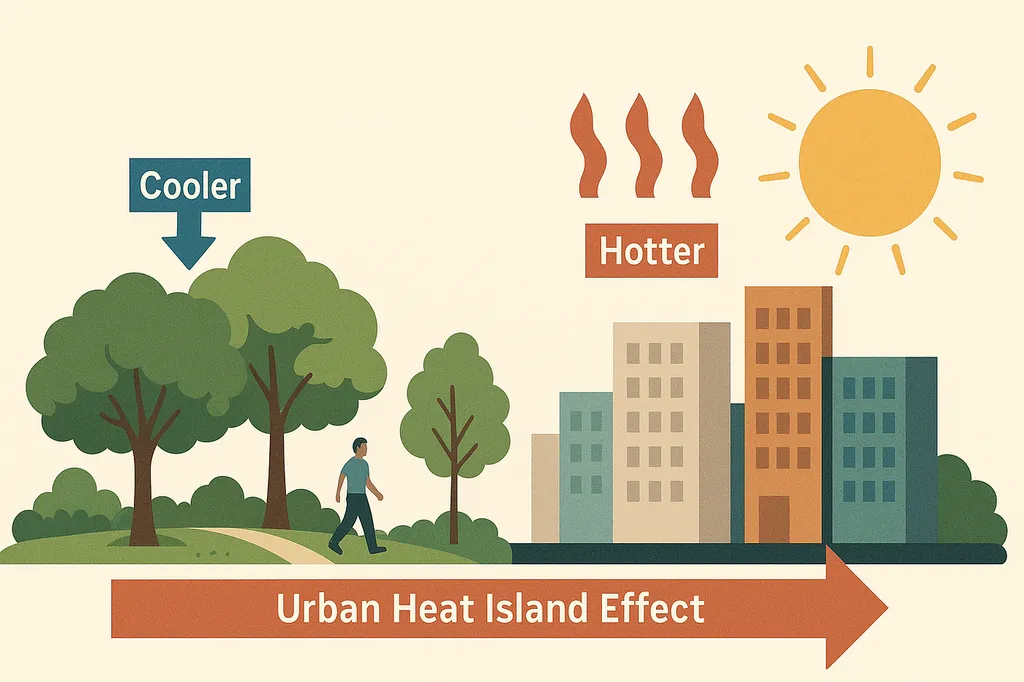
In the heart of the UK, a groundbreaking study is reshaping our understanding of urban heat islands and their impact on temperate cities. Tania Sharmin, a researcher at the Welsh School of Architecture, Cardiff University, has published a compelling analysis in the journal *Energy and Built Environment* (translated to English as “Energy and Built Environment”), shedding light on how urban morphology influences land surface temperature (LST), vegetation, and the surface urban heat island (SUHI) effect in Cardiff.
Sharmin’s research focuses on the spatiotemporal variations of LST, the normalized difference vegetation index (NDVI), and SUHI within the context of local climate zones (LCZs). Her findings reveal significant variations in SUHI across different LCZs, with built-up areas exhibiting higher temperatures compared to natural classes. “A more compact built-environment with smaller vegetation cover and larger building density was found to be 2.0 °C warmer than the open built-environment,” Sharmin explains. This temperature difference highlights the critical role of urban planning in mitigating heat island effects.
The study’s implications for the energy sector are profound. As cities grapple with the challenges of climate change, understanding the relationship between urban form and temperature can inform strategies to reduce energy consumption and improve resilience. “The high-density, built-up LCZs have a greater SUHI effect compared to the natural classes,” Sharmin notes. This insight suggests that incorporating more greenery and open spaces into urban design can significantly lower temperatures, reducing the demand for energy-intensive cooling solutions.
The research also underscores the importance of international collaboration and comparison. By applying the LCZ map to Cardiff, Sharmin’s work enables cities with similar climates to test and adapt proven techniques for climate change mitigation and adaptation. This collaborative approach can drive innovation in urban planning and energy efficiency, benefiting both the environment and the economy.
As cities around the world seek to become more sustainable and resilient, Sharmin’s findings offer a valuable roadmap. By prioritizing open built-environments with sufficient greenery and open spaces, urban planners and policymakers can create cooler, more energy-efficient cities. This shift not only enhances the quality of life for residents but also opens up new opportunities for the energy sector to develop and deploy innovative solutions.
In an era of rapid urbanization and climate change, Sharmin’s research serves as a timely reminder of the power of data-driven decision-making. By leveraging the insights from this study, cities can take proactive steps to mitigate the impacts of urban heat islands and build a more sustainable future. As the energy sector continues to evolve, the lessons learned from Cardiff could well shape the next generation of urban design and energy strategies.