
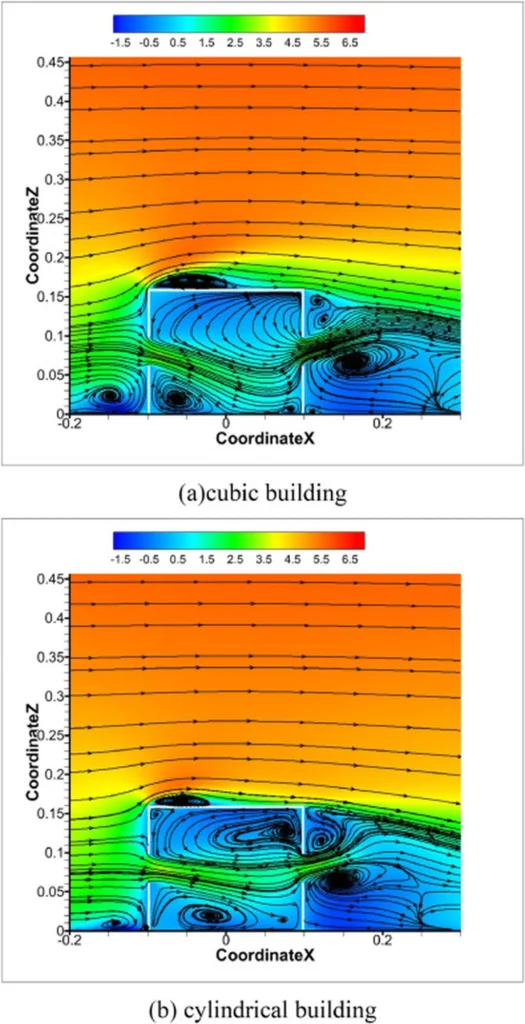
In the quest for energy-efficient buildings, a recent study published in the journal *Energy and Built Environment* (translated from Chinese as *能源与建筑环境*) has shed new light on the dynamics of cross-ventilation, offering promising insights for architects and engineers aiming to design more sustainable structures. Led by Puxian Ding from the Green Cold Chain and Supply Chain Collaborative Innovation Center at Guangzhou Panyu Polytechnic, the research delves into the often-overlooked impact of a building’s shape on airflow, revealing how cylindrical designs could significantly enhance natural ventilation.
Cross-ventilation, the process by which wind drives air through a building, is a cornerstone of passive cooling strategies. It requires no energy consumption, making it an attractive option for reducing a building’s carbon footprint. However, the effectiveness of cross-ventilation has historically been tied to the building’s geometry, with most studies focusing on rectangular or square structures. Ding’s research breaks new ground by examining the airflow dynamics in cylindrical buildings, a design that has seen limited exploration despite its potential benefits.
Using advanced computational fluid dynamics (CFD) simulations, Ding and his team modeled the cross-ventilation flow in an isolated cylindrical building, validating their results against experimental data. The findings were striking: the cylindrical design demonstrated an 8.3% improvement in volume ventilation rate and a 1.38 times higher air exchange rate compared to a square building of similar size. “The curved walls of the cylindrical building allow air to flow more horizontally, reducing pressure loss and facilitating better airflow,” Ding explained. This improved airflow not only enhances indoor air quality but also reduces the need for mechanical ventilation systems, leading to significant energy savings.
The study also revealed that while square buildings experience greater outdoor airflow fluctuations, cylindrical buildings exhibit increased indoor turbulence. This turbulence, though initially counterintuitive, can be beneficial. “It helps to mix the air more thoroughly inside the building, ensuring that pollutants and heat are more effectively expelled,” Ding noted. This finding challenges conventional wisdom and opens up new avenues for designing buildings that leverage natural forces to maintain comfortable and healthy indoor environments.
The commercial implications of this research are substantial. As the global push for energy efficiency intensifies, architects and developers are increasingly turning to passive design strategies to meet regulatory standards and appeal to environmentally conscious clients. The insights from Ding’s study could influence the design of future buildings, particularly in urban areas where space constraints often favor compact, cylindrical structures. “This research provides a strong case for reconsidering the shape of our buildings,” Ding said. “By optimizing the geometry, we can achieve significant energy savings without compromising on comfort or aesthetics.”
Moreover, the findings could have a ripple effect across the energy sector. Reduced reliance on mechanical ventilation systems means lower energy consumption, which in turn decreases the demand for power generation. This aligns with broader goals of reducing greenhouse gas emissions and mitigating climate change. As the construction industry continues to evolve, the integration of such innovative design principles could become a standard practice, shaping the future of sustainable architecture.
In conclusion, Ding’s research offers a compelling argument for the adoption of cylindrical designs in building construction. By harnessing the power of natural ventilation, architects and engineers can create structures that are not only energy-efficient but also more comfortable and healthier for occupants. As the world grapples with the challenges of climate change and energy scarcity, such innovations are more important than ever. The study’s publication in *Energy and Built Environment* underscores its relevance and potential impact, setting the stage for a new era of sustainable design.