
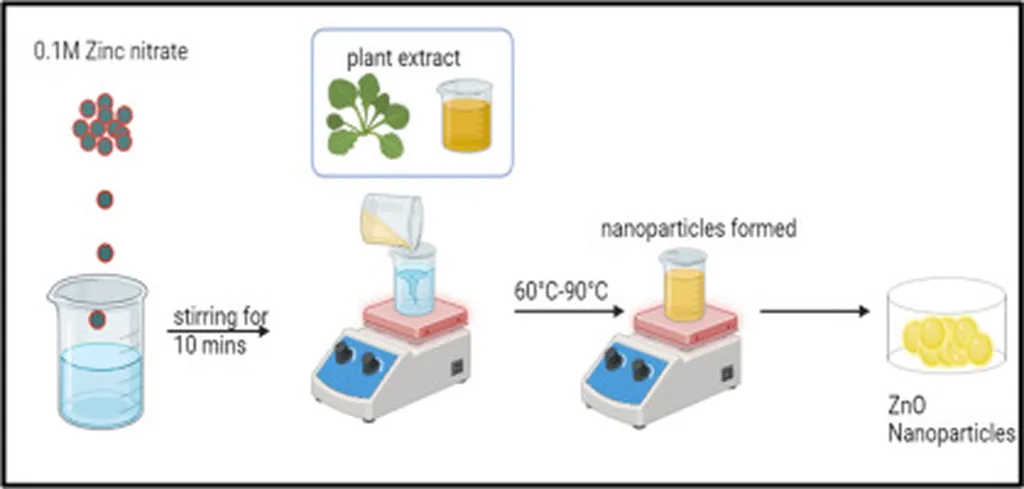
In a groundbreaking development that could reshape the landscape of sustainable materials science, researchers have successfully synthesized zinc oxide nanoparticles (ZnONPs) using an eco-friendly, plant-based approach. This innovative method, detailed in a recent study published in the journal *Nanomaterials and Nanotechnology* (which translates to “纳米材料与纳米技术” in Chinese), leverages the natural properties of Alternanthera philoxeroides, a common aquatic plant, to create nanoparticles with significant antioxidant and antibacterial properties.
At the helm of this research is Ruchika Sharma, a chemist from the Department of Chemistry, who explains the motivation behind the study: “The growing demand for sustainable and nontoxic synthesis methods has driven our exploration of green chemistry approaches. Traditional methods of nanoparticle synthesis often involve hazardous chemicals and energy-intensive processes. By contrast, our method is not only environmentally benign but also cost-effective.”
The process involves using an aqueous leaf extract of Alternanthera philoxeroides as a natural reducing and stabilizing agent, combined with zinc acetate as the precursor salt. The resulting ZnONPs exhibit a characteristic surface plasmon resonance (SPR) band at 351 nm, confirming their formation. Energy dispersive X-ray (EDX) analysis further validated the presence of elemental zinc and oxygen, while Fourier transform infrared (FTIR) spectroscopy revealed the phytochemicals responsible for the reduction and capping of the nanoparticles.
One of the most compelling aspects of this research is the potential applications of these bio-synthesized ZnONPs. The study demonstrated strong antibacterial activity, particularly against Staphylococcus aureus, a bacterium known for its resistance to many antibiotics. Additionally, the nanoparticles exhibited significant antioxidant activity, with a half-maximal inhibitory concentration (IC50) of 85.42 μg/mL in the DPPH free radical scavenging assay.
The implications for the energy sector are profound. Zinc oxide nanoparticles are already used in various applications, including solar cells, batteries, and energy storage devices. The development of a sustainable and nontoxic synthesis method could significantly reduce the environmental impact of these technologies. As Sharma notes, “The potential for scalable, green synthesis methods like ours could revolutionize the way we produce and utilize nanomaterials in the energy sector.”
Moreover, the moderate stability of the nanoparticles, as indicated by a zeta potential of -16.4 mV, suggests that they could be engineered for targeted drug delivery and other biomedical applications. The crystalline wurtzite structure, confirmed by X-ray diffraction (XRD) and selected area electron diffraction (SAED) patterns, further enhances their potential for use in advanced materials science.
The study’s findings open up new avenues for research and development in the field of green nanotechnology. As the world increasingly turns to sustainable solutions, the bio-synthesis of ZnONPs represents a significant step forward. The research not only highlights the potential of natural resources in creating advanced materials but also underscores the importance of interdisciplinary collaboration in driving innovation.
In the words of Sharma, “This research is just the beginning. The possibilities are vast, and we are excited to explore the full potential of bio-synthesized nanoparticles in various applications.” As the scientific community continues to push the boundaries of green chemistry, the work of Sharma and her team serves as a beacon of inspiration and a testament to the power of sustainable innovation.