
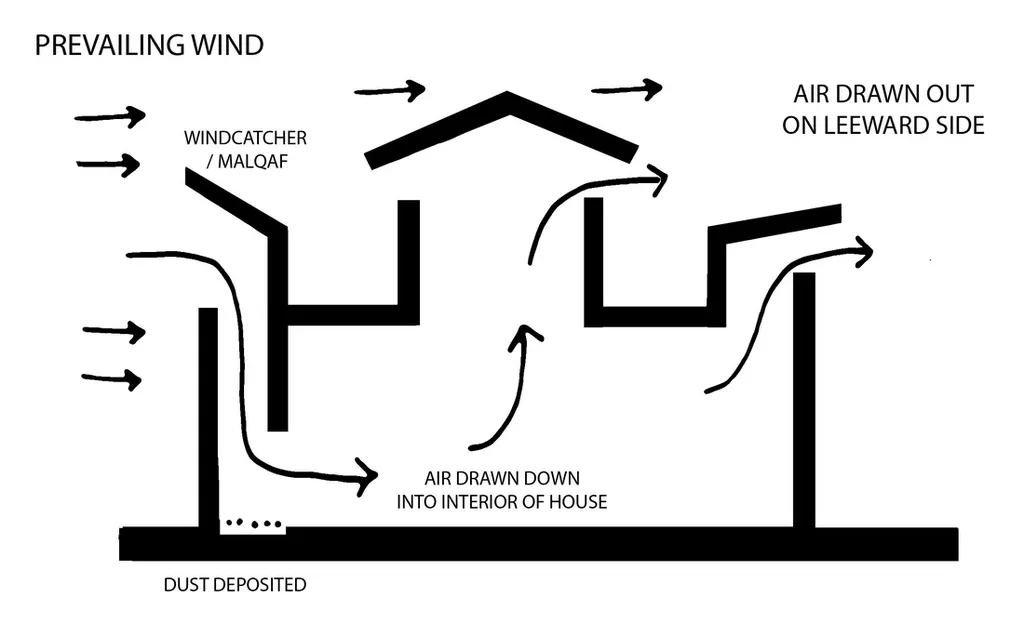
In the quest for sustainable and energy-efficient buildings, a team of researchers led by Dr. Jiaxiang Li from the University of Nottingham and the Eastern Institute of Technology in China has made a significant breakthrough. Their work, published in the journal *Energy and Built Environment* (which translates to *Energy and Built Environment* in English), focuses on enhancing the performance of windcatchers, ancient devices that have been modernized to provide natural ventilation in buildings.
Windcatchers, or wind towers, have been used for centuries in the Middle East and other regions to cool buildings naturally. However, their effectiveness is often hampered by changing wind directions and environmental factors. Dr. Li and his team addressed this challenge by developing a novel dual-channel windcatcher system equipped with a rotary wind scoop. This innovation ensures a consistent supply of fresh air and efficient exhaust of stale air, regardless of wind direction.
The team employed computational fluid dynamics (CFD) to optimize the design. “By incorporating technologies like an anti-short-circuit device and wing walls, and making modifications such as a larger wind scoop area and a redesigned wind cowl, we significantly improved the system’s performance,” explained Dr. Li. The modified windcatcher achieved a 28% improvement in ventilation rate and outperformed a conventional four-sided windcatcher of the same size by up to 58%.
The implications for the energy sector are substantial. As buildings account for a significant portion of global energy consumption, enhancing natural ventilation systems can lead to reduced reliance on mechanical cooling and heating systems, thereby lowering energy costs and carbon emissions. Dr. Li’s research provides a blueprint for more efficient windcatcher systems, paving the way for further integration of passive and low-energy technologies.
The study also conducted full-scale simulations of the building and windcatcher at varying heights under atmospheric boundary layer wind flow, providing a realistic assessment of the windcatcher’s performance. This holistic approach ensures that the system is not only theoretically sound but also practically viable.
The research contributes to the ongoing efforts to make buildings more sustainable and energy-efficient. As Dr. Li noted, “Our findings highlight the potential of integrating advanced technologies with traditional designs to create more effective and sustainable ventilation solutions.” This work is a testament to the power of innovation in addressing contemporary challenges in the built environment.
In the broader context, this research could shape future developments in the field of natural ventilation. By demonstrating the effectiveness of the dual-channel windcatcher system, Dr. Li and his team have set a new standard for passive ventilation technologies. As the world increasingly turns to sustainable solutions to combat climate change, such innovations will play a crucial role in reducing energy consumption and enhancing the comfort and health of building occupants.
The study published in *Energy and Built Environment* serves as a catalyst for further research and development in this area, inspiring engineers, architects, and policymakers to embrace and implement these advanced ventilation systems in their projects. The future of building design is increasingly leaning towards sustainability, and Dr. Li’s work is a significant step in that direction.