
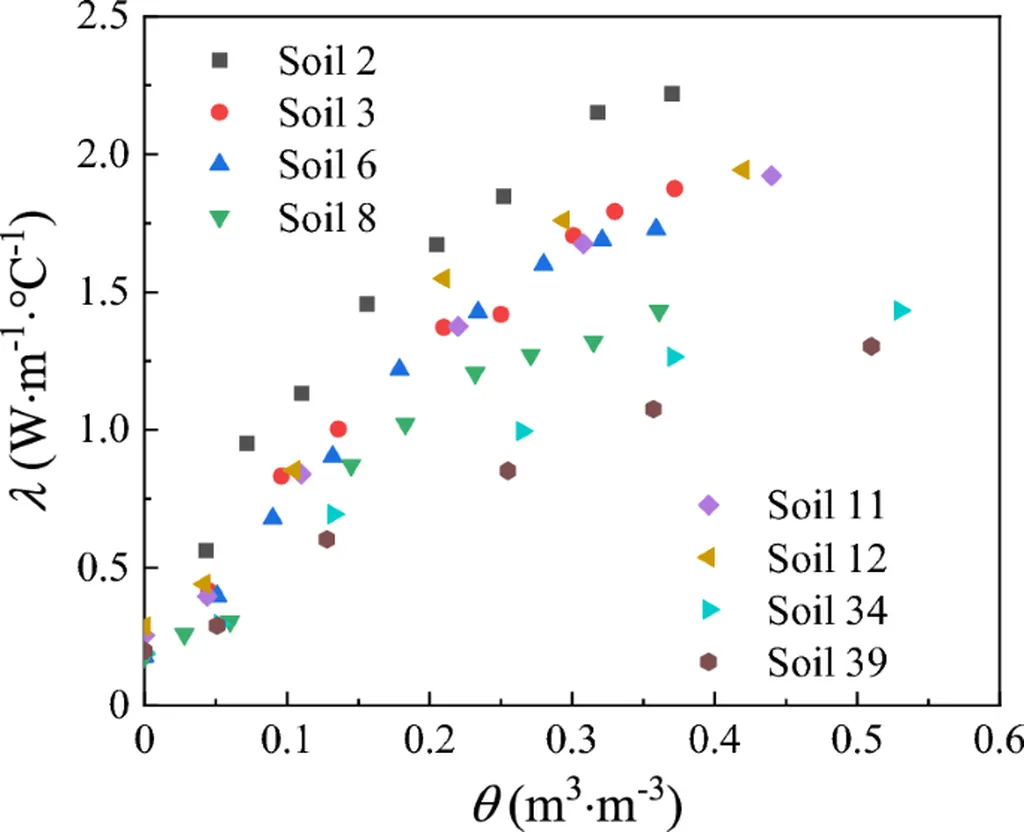
In the realm of geothermal energy and infrastructure development, understanding soil thermal conductivity is paramount. A recent study led by Wenguo Huang from China Railway Communications Investment Group Co., Ltd., and published in *Advances in Materials Science and Engineering* (translated from Chinese), has taken a significant step forward in this area. The research reviews and evaluates six models predicting soil thermal conductivity at moderate to high temperatures, ranging from 5°C to 90°C, offering valuable insights for the energy sector.
The study collected 381 soil thermal conductivity data points measured by Chinese and Japanese researchers, creating a robust database to evaluate the performance of six different prediction models. The results were compelling: all models showed good prediction accuracy, but notable differences emerged. “Chenhui Liu’s model performed best, with a Nash efficiency coefficient (NSE) of 0.9380 and a root mean square error (RMSE) of 0.1785 W/(mK),” Huang explained. “On the other hand, the deV-1 model showed relatively weaker performance, with an NSE of 0.6580 and an RMSE of 0.4191 W/(mK).”
The research also highlighted that the prediction accuracy tended to decrease as temperature increased, particularly when the moisture content was slightly lower than the permanent wilting point (θPWP). This phenomenon is attributed to the reduction in soil water holding capacity at higher temperatures, leading to an underestimation of the thermal conductivity contributed by the latent heat effect of water vapor.
The implications for the energy sector are substantial. Accurate prediction of soil thermal conductivity is crucial for designing efficient geothermal systems, managing heat storage, and ensuring the stability of infrastructure in varying temperature conditions. “This research provides a unified evaluation of six soil thermal conductivity models in the middle and high temperature range for the first time,” Huang noted. “The database fills a critical data gap for soils with East Asian characteristics, offering a solid foundation for model selection in related projects.”
As the world increasingly turns to renewable energy sources, understanding the thermal properties of soil becomes ever more important. This study not only advances scientific knowledge but also offers practical tools for engineers and developers in the energy sector. By providing a reliable database and evaluating existing models, Huang’s research paves the way for more accurate and efficient geothermal applications, ultimately contributing to a more sustainable energy future.