
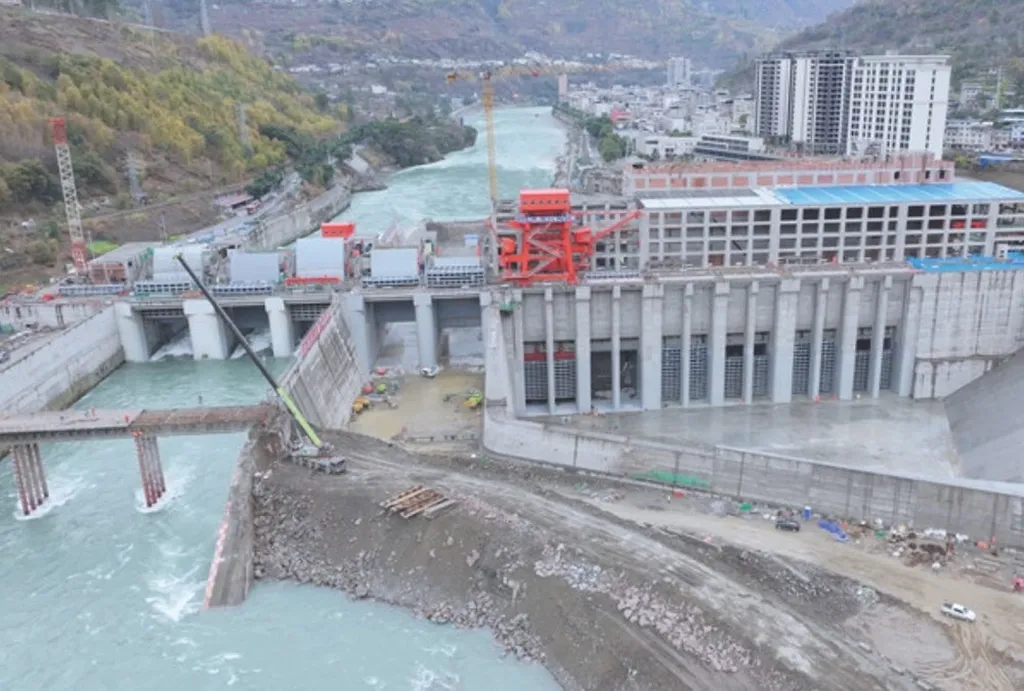
In the heart of China’s energy sector, a groundbreaking study is set to redefine construction standards and boost efficiency in water conservancy and hydropower projects. Liwen Hu, a leading researcher from PowerChina Sinohydro Engineering Bureau 4 Co., Ltd., based in Lanzhou, has spearheaded an experimental study that challenges conventional wisdom and promises significant economic benefits.
The study, published in the esteemed journal *Frontiers in Built Environment* (translated to English as “Frontiers in the Built Environment”), focuses on roller compacted asphalt concrete (RCAC) impervious core walls, a critical component in water conservancy and hydropower projects. Traditionally, the industry has adhered to a single-layer paving thickness of 30 cm, compacted to 25 cm. However, this standard has long been a bottleneck in construction efficiency and economy.
Hu’s research, conducted at the Hongshuihe Reservoir Project in Suzhou District of Jiuquan City, explores the feasibility of increasing the paving thickness to 38 cm and above. The findings are nothing short of transformative. “The physical and mechanical properties of asphalt concrete meet the requirements of design specifications under the condition of paving thickness of 38 cm,” Hu asserts. This breakthrough could revolutionize the industry, offering substantial savings in both time and cost.
The study involved field layered paving tests, examining the influence of three different rolling times on the compactness, permeability, and mechanical properties of asphalt concrete. Using non-destructive testing and core sample testing methods, the team measured density, permeability coefficient, and tensile, compressive, and flexural properties. The results were compelling. Increased rolling times significantly optimized density and permeability coefficient, with tensile strength, compressive strength, and bending resistance all reaching standard indices.
One of the most striking findings was the improvement in interlayer bonding quality. “The bonding quality between the layers is good, and the appearance of the core sample has no obvious delamination trace,” Hu notes. This is a critical factor in ensuring the longevity and safety of the structures.
The economic implications are substantial. Compared to the current 30 cm thickness scheme, the 38 cm thickness can reduce the number of construction layers by about 69, save the construction period by 35 days, and reduce construction costs by approximately 628,400 yuan. These savings translate to faster project completion and lower operational costs, a boon for the energy sector.
The study not only confirms the feasibility of increasing the paving thickness of asphalt concrete to 38 cm under existing equipment and process conditions but also highlights the clear influence of different rolling times on performance indices. Optimizing the second rolling times can ensure paving quality and engineering safety, providing a robust framework for future construction practices.
As the energy sector continues to evolve, research like Hu’s is pivotal in driving innovation and efficiency. The findings offer important data support and reference for the construction technology optimization and specification revision of RCAC core walls. This study is a testament to the power of scientific inquiry in shaping the future of the built environment, promising a more efficient and economically viable landscape for water conservancy and hydropower projects.