
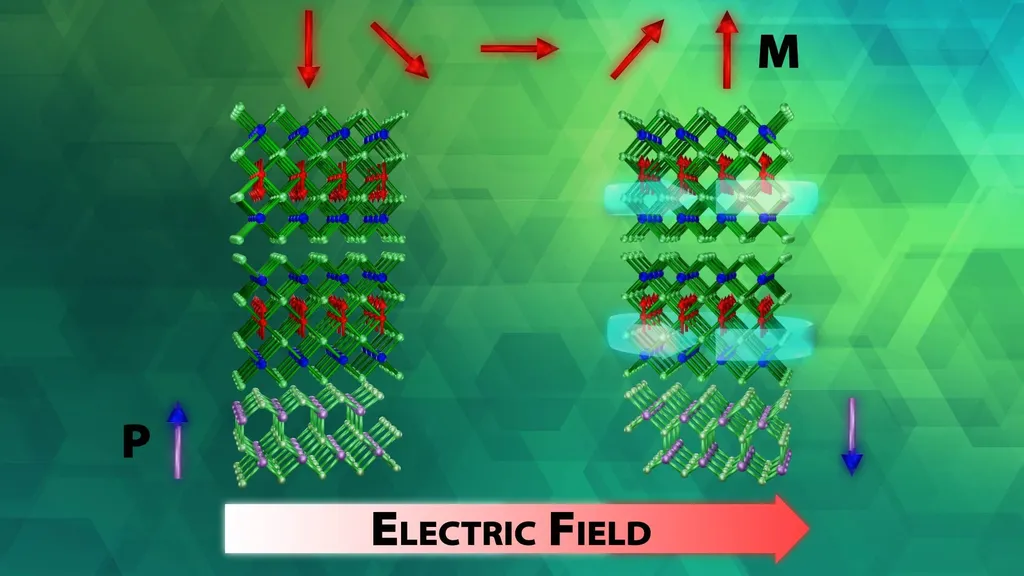
In the realm of topological materials, a breakthrough has emerged that could significantly impact the energy sector and beyond. Researchers have developed a novel approach to precisely calculate the surface states of three-dimensional lattice models, offering a powerful tool for understanding and harnessing the unique properties of topological insulators and Weyl semimetals.
At the heart of this advancement is Matias Mustonen, a researcher at the Computational Physics Laboratory, Physics Unit, Faculty of Engineering and Natural Sciences at Tampere University in Finland. Mustonen and his team have introduced a generalized transfer matrix method that provides exact analytical and numerical solutions for lattice versions of topological models with surface termination in one direction. This method circumvents the limitations of previous approaches, which often relied on singular, non-invertible inter-layer hopping matrices.
“The beauty of our method lies in its versatility and precision,” Mustonen explains. “It allows us to derive exact solutions for surface states and Fermi arc states in various topological models, providing a comprehensive understanding of their behavior.”
The team applied their formalism to two prototypical topological models: the 3D Bernevig–Hughes–Zhang model and a lattice model exhibiting Weyl semimetal behavior. Their results demonstrated that the surface states and bulk bands, across the projected two-dimensional Brillouin zone, agreed perfectly with those obtained through direct numerical diagonalization of the corresponding Hamiltonians in a slab geometry.
This breakthrough is not just an academic achievement; it has significant commercial implications, particularly for the energy sector. Topological insulators and Weyl semimetals are known for their unique electronic properties, which could revolutionize the development of energy-efficient devices. By providing exact solutions for surface states, this research paves the way for more accurate modeling and design of topological materials, potentially leading to the creation of novel energy technologies.
“The potential applications of our method are vast,” Mustonen adds. “From improving the efficiency of solar cells to developing more powerful quantum computers, our work could have far-reaching impacts on various industries.”
Published in the Journal of Physics Materials, this research highlights the importance of fundamental scientific inquiry in driving technological innovation. As we continue to explore the fascinating world of topological materials, the work of Mustonen and his team serves as a beacon, guiding us towards a future powered by cutting-edge energy solutions.