
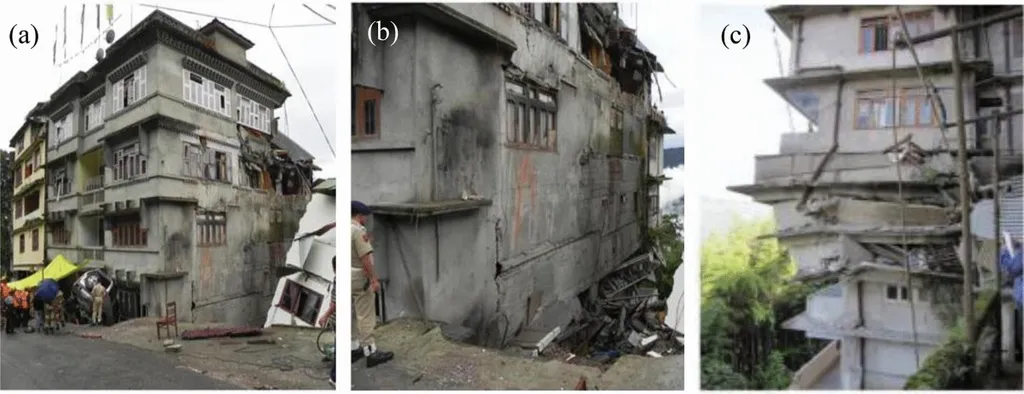
In the heart of India’s mountainous regions, a pressing question looms over construction professionals: how can we build reinforced concrete (RC) buildings on slopes that can withstand the mighty forces of earthquakes? Dhimant Parmar, a researcher from the School of Civil Engineering at Vellore Institute of Technology, has taken a significant stride towards answering this question. His study, published in the journal ‘Frontiers in Built Environment’ (which translates to ‘Frontiers in the Built Environment’), is shedding new light on the seismic performance of various structural configurations for RC buildings on sloped terrain.
Parmar’s research is a game-changer because it considers the entire system—soil, foundation, and structure—using a comprehensive modeling approach. “Most studies focus solely on the structure,” Parmar explains, “but we’ve found that ignoring the soil and foundation interactions can lead to a significant underestimation of a building’s vulnerability.”
The study delves into the performance of five-story RC buildings at three critical slope locations: the toe, crest, and center, all at a 20° inclination. Parmar and his team investigated various structural configurations, including bracings, shear walls, grade beams, stub columns, strap footings, and hybrid arrangements. The results are striking. Buildings on sloping ground were found to be much more vulnerable than those on level ground, with bare-frame structures performing the worst across all slope locations.
However, the news isn’t all bleak. Parmar’s research highlights that incorporating bracings and shear walls can dramatically improve a building’s seismic performance. “We’ve seen reductions of up to 90% in both lateral displacement and inter-story drift ratio compared to typical bare-frame systems,” Parmar reveals. Hybrid configurations, such as the M26 model, also showed promising results, reducing critical shear force and bending moment exploitation ratios by up to 2.3× and 1.5×, respectively.
The commercial implications of this research are substantial. For the energy sector, which often requires infrastructure in challenging terrains, these findings could translate into safer, more resilient power plants, transmission towers, and other critical facilities. “Understanding how to optimize structural configurations on slopes can minimize damage and reduce social losses in a community,” Parmar emphasizes. This aligns with the United Nations’ Sustainable Development Goals 9 and 11, which aim to build sustainable cities and resilient communities.
Parmar’s work is particularly relevant to professionals in soil-structure interaction, sloped terrain construction, continuum modeling, and step-back building design. His findings provide valuable guidelines for creating seismically resilient structural designs, which could significantly improve the safety and performance of RC buildings under seismic loads in mountainous terrain.
As the construction industry continues to evolve, Parmar’s research serves as a reminder of the importance of considering the entire soil-foundation-structure system. His work not only fills a gap in the current guidelines provided by Indian Standards but also paves the way for future developments in the field. With this new knowledge, construction professionals can make more informed decisions, ultimately leading to safer, more resilient buildings in even the most challenging terrains.