
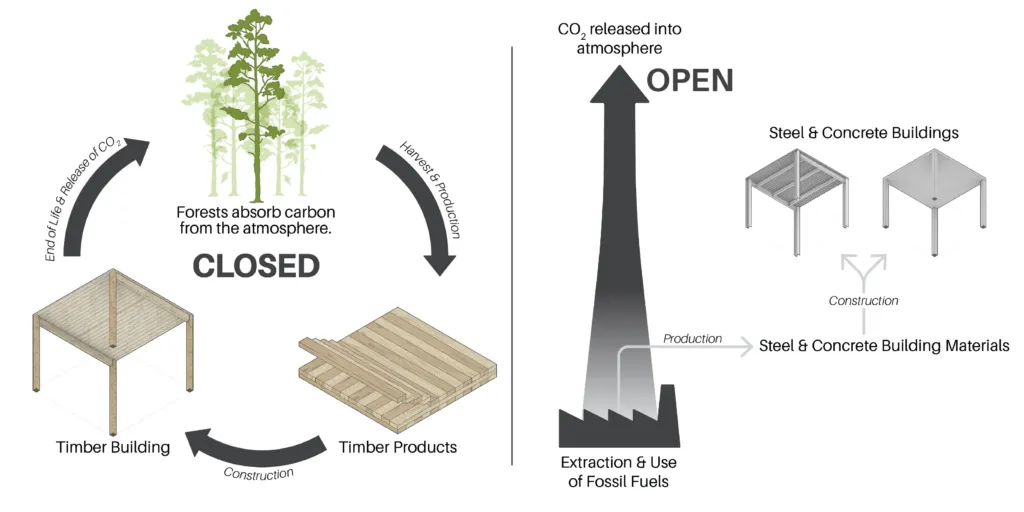
In the quest to build more sustainable and adaptable structures, mass timber (MT) has emerged as a promising material, offering significant carbon sequestration benefits. However, the true potential of MT lies not just in its eco-friendly properties but also in its ability to be designed for adaptability, extending the lifespan of buildings and delaying end-of-life interventions. A recent study published in the journal *Frontiers in Built Environment* (translated from English) sheds light on how stakeholders in the construction industry can better integrate adaptability into their mass timber projects.
Led by Nastaran Hasani of the Wood Science and Engineering Department at Oregon State University, the research maps out the decision-making processes in real-world MT project workflows. The study identifies who makes critical decisions, when these decisions are made, and which digital tools are used. By analyzing 106 responses from a global questionnaire survey, the research pinpoints four key criteria for adaptable design: structural grid configuration, standardization and compatibility, modularity and scalability, and the location of building cores and services.
The findings reveal that the schematic design and construction documentation phases are crucial for making adaptability-related decisions. However, certain disciplines are often left out when their input is most needed. “A convergent design approach that brings all the key actors together is essential at key points,” Hasani emphasizes. This approach ensures that all relevant stakeholders, particularly MT manufacturers and fabricators, are involved in the decision-making process.
The study also highlights the underutilization of parametric and simulation workflows, which can support rapid iteration and real-time feedback in design exploration. These tools, when coupled with analysis and simulation tools, can accelerate progress from schematic design to fabrication drawings. “Parametric and simulation workflows support stakeholders in co-evaluating adaptability and other design objectives simultaneously,” Hasani notes. This integration can lead to more efficient and effective design processes.
The implications of this research are significant for the construction industry, particularly in the context of the circular economy. By designing buildings that are durable and capable of future adaptation, the industry can maximize the carbon sequestration benefits of mass timber and contribute to more sustainable urban development. The study’s outcomes can inform future strategies for improving early-stage collaboration and tool interoperability, ultimately supporting the design of adaptable mass timber buildings.
As the construction industry continues to evolve, the insights from this research can shape future developments in the field. By fostering a more collaborative and integrated approach to design, the industry can build structures that are not only sustainable but also adaptable to the changing needs of society. The study’s findings serve as a call to action for stakeholders to embrace convergent design approaches and leverage digital tools to create buildings that stand the test of time.