
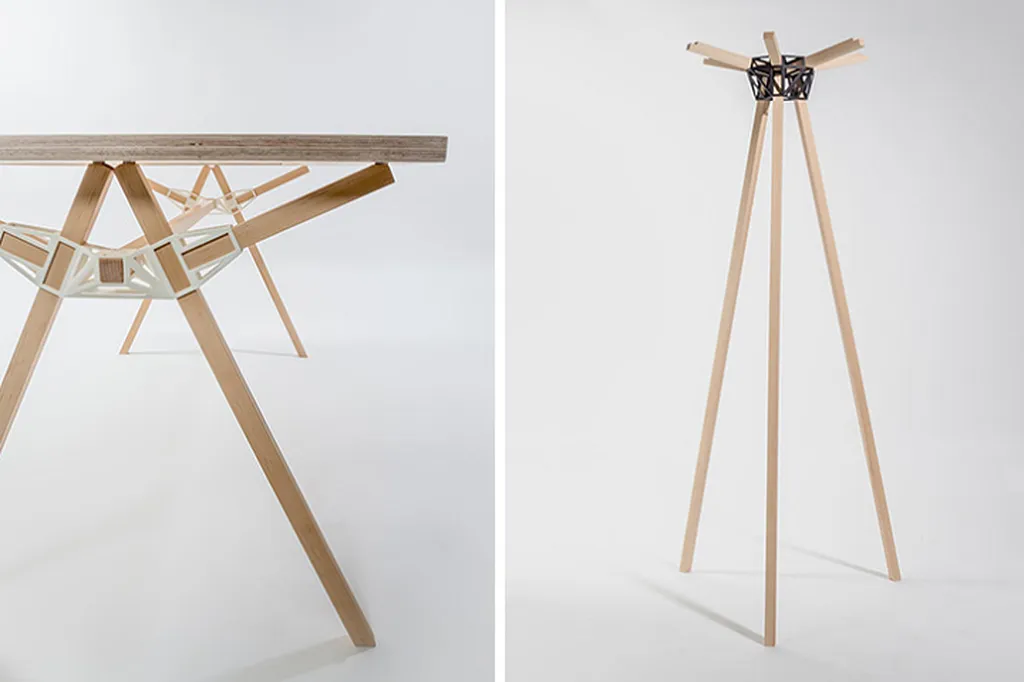
In the ever-evolving world of construction and furniture manufacturing, a groundbreaking study led by Tolga Kuşkun from Muğla Sıtkı Koçman University’s Faculty of Technology is making waves. The research, published in the Gazi Üniversitesi Fen Bilimleri Dergisi (Gazi University Journal of Science), delves into the performance of L-type furniture corner joints connected with dowels produced using 3D printing technology. The findings could have significant implications for the furniture industry and beyond, particularly in the energy sector where precision and durability are paramount.
The study focused on the moment capacities and elasticities of L-type furniture corner joints, a critical aspect of furniture construction. Kuşkun and his team explored the impact of different orientations in 3D printing dowels, using two types of filament materials: Acrylonitrile Butadiene Styrene (ABS) and Acrylonitrile Styrene Acrylate (ASA). The dowels were printed in two orientations—vertical and horizontal—to understand how this variable affects joint performance.
“Our goal was to investigate how the orientation of 3D-printed dowels influences the structural integrity of furniture joints,” Kuşkun explained. “We also wanted to see how different materials and the number of dowels impact the overall strength and elasticity of the joints.”
The team prepared 80 L-type corner joint specimens, varying the printing orientation, the number of dowels (two or three), and the material used. Half of the specimens were tested under static diagonal tension, while the other half underwent static diagonal compression. To ensure accuracy, numerical analyses were performed using the finite element method (FEM) for each group.
The results were enlightening. Joints made with ASA dowels outperformed those made with ABS, and horizontally printed dowels proved stronger than vertically printed ones. Increasing the number of dowels from two to three also enhanced the moment capacity and elasticity of the joints. “The consistency between our experimental results and the numerical analyses using FEM was particularly encouraging,” Kuşkun noted. “This consistency gives us confidence in the reliability of our findings.”
The commercial impacts of this research are substantial. For the furniture industry, understanding how to optimize 3D-printed dowels can lead to more durable and cost-effective products. In the energy sector, where precision and durability are critical, these findings could influence the design and construction of components that require high structural integrity.
As the construction and manufacturing industries continue to embrace 3D printing technology, this research provides valuable insights into how to maximize the performance of 3D-printed components. The study’s findings could pave the way for more innovative and efficient designs, ultimately shaping the future of furniture manufacturing and other industries that rely on strong, reliable joints.
In a world where sustainability and efficiency are increasingly important, Kuşkun’s research offers a glimpse into the future of construction and manufacturing. By leveraging the power of 3D printing and advanced materials, industries can achieve greater precision, durability, and cost-effectiveness. As the technology continues to evolve, the insights gained from this study will undoubtedly play a crucial role in shaping the next generation of construction and manufacturing practices.