
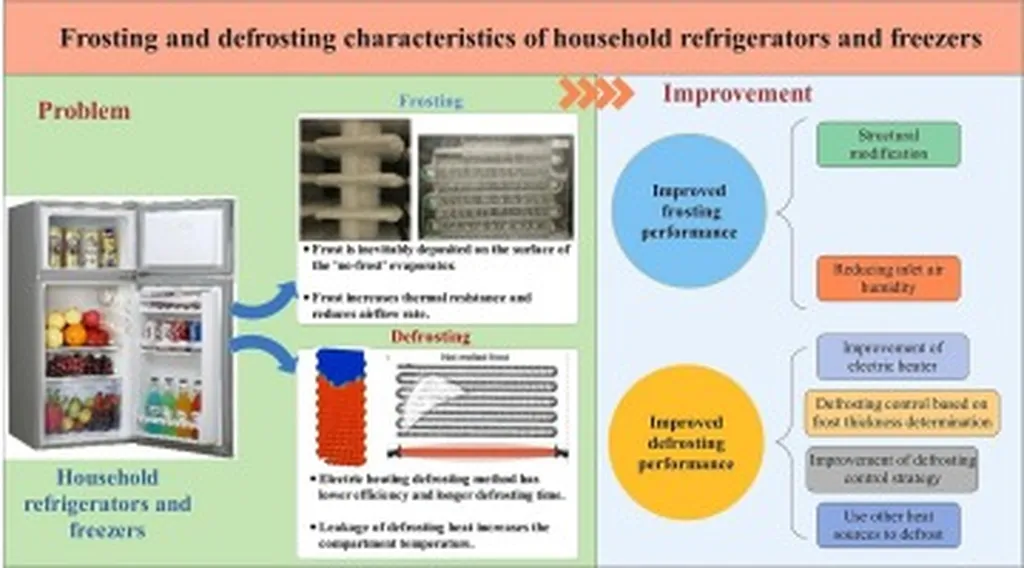
In the quest for energy efficiency, researchers have turned their attention to an often-overlooked culprit in air-cooled refrigerators: non-uniform frosting. A recent study, led by HAN Xudong, delves into the complexities of this phenomenon, offering insights that could reshape the energy sector.
Non-uniform frosting, a common issue in air-cooled refrigerator evaporators, is more than just a nuisance. It’s a significant factor in the performance degradation of these systems. “Non-uniform frost is a significant feature of evaporator surface frost in air-cooled refrigerators,” HAN Xudong explains. “It’s also one of the important causative factors leading to evaporator performance degradation.”
The study, published in ‘Zhileng xuebao’ (translated to English as ‘Refrigeration Journal’), reviews existing research in three key areas: the characteristics of non-uniform frost, defrost optimization, and frost detection optimization. The researchers found that non-uniform frosting can significantly impact the efficiency of air-cooled refrigerators, leading to increased energy consumption and reduced performance.
One of the most compelling aspects of this research is its potential commercial impact. By understanding the formation mechanism of non-uniform frost and its influencing factors, manufacturers can develop more efficient defrosting strategies. This could lead to significant energy savings, a critical consideration in today’s energy-conscious world.
The study also highlights the challenges of frost detection under non-uniform frost conditions. Direct and indirect detection techniques both face complex hurdles, but the research offers potential solutions that could pave the way for more accurate and efficient frost detection systems.
Looking ahead, the study identifies several shortcomings in the current research field and proposes future development directions. These include improving frost-heat matching defrosting strategies and enhancing frost suppression techniques. By addressing these areas, researchers could further optimize the performance of air-cooled refrigerators, contributing to a more energy-efficient future.
As HAN Xudong notes, “This study aims to provide a framework for the efficient operation and energy-saving optimization of air-cooled refrigerators.” With the insights gained from this research, the energy sector could be on the cusp of a significant leap forward in refrigerator technology. The implications are not just academic; they’re practical, promising a future where our cooling systems are more efficient, more reliable, and more sustainable.