
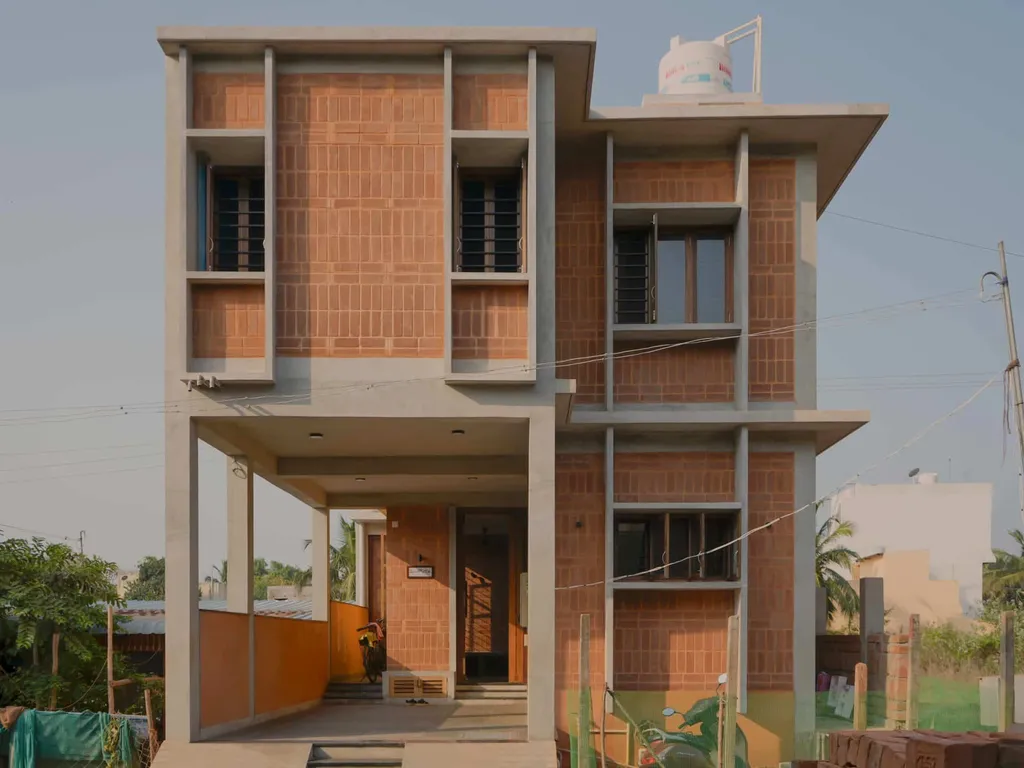
In the heart of Pondicherry, a heritage town where urban densification has led to deep-plan buildings with limited access to daylight and natural ventilation, a novel approach to passive design is emerging. Chandrasekaran Chockalingam, a researcher from the Vellore Institute of Technology’s School of Architecture, has been exploring the integration of light wells to enhance indoor environmental quality in such contexts. His recent study, published in the *Journal of Daylighting* (which translates to *Journal of Natural Light* in English), offers a compelling case for the use of generative design in creating sustainable, energy-efficient buildings.
Chockalingam’s research focuses on a typical deep-plan residential plot in Pondicherry, characterized by a width of just 6 meters and a depth of 20 meters, with a three-storey building standing 14.4 meters tall. Using advanced tools like Rhino 7, Grasshopper, Ladybug, Honeybee Radiance, and Design Builder, he conducted evolutionary generative simulations to evaluate variations in the size, number, and placement of light wells. The goal was to optimize daylighting and natural ventilation, crucial for achieving thermal and visual comfort in such dense urban settings.
“The challenge was to find a balance between maximizing daylight penetration and ensuring effective natural ventilation,” Chockalingam explained. “Through generative design, we were able to explore a wide range of possibilities and identify the most effective configurations.”
The study found that double light wells arranged perpendicularly provided the best results, with a mean Useful Daylight Illuminance (UDI) above 50% and Air Changes per Hour (ACH) ranging from 5.06 to 1.33. Notably, all high-performing light wells had a volume of more than 20% of the total built-up volume. The most effective design featured double rectangular light wells measuring 3.5 by 2.5 meters.
This research is not just an academic exercise; it has significant commercial implications for the energy sector. By integrating passive systems like light wells, buildings can reduce their reliance on artificial lighting and mechanical ventilation, leading to substantial energy savings. In a world increasingly focused on sustainability, such innovations are crucial.
“The potential for energy savings is enormous,” Chockalingam noted. “By optimizing daylighting and natural ventilation, we can significantly reduce the energy consumption of buildings, contributing to a more sustainable future.”
The use of generative design in this context is particularly noteworthy. This approach allows architects and designers to explore a vast array of design options quickly and efficiently, identifying the most effective solutions for specific contexts. As Chockalingam’s research demonstrates, this can lead to innovative, sustainable designs that enhance indoor environmental quality and reduce energy consumption.
Looking ahead, this research could shape future developments in the field of architecture and construction. By integrating passive systems through generative design, buildings can be made more sustainable and energy-efficient, contributing to a greener, more sustainable future. As the world grapples with the challenges of climate change, such innovations will be increasingly important.
In the words of Chockalingam, “This is just the beginning. The potential for generative design in creating sustainable, energy-efficient buildings is immense, and I am excited to see how this field will evolve in the coming years.”
As the construction industry continues to evolve, the integration of passive systems through generative design offers a promising path forward. With researchers like Chandrasekaran Chockalingam leading the way, the future of sustainable architecture looks bright.