
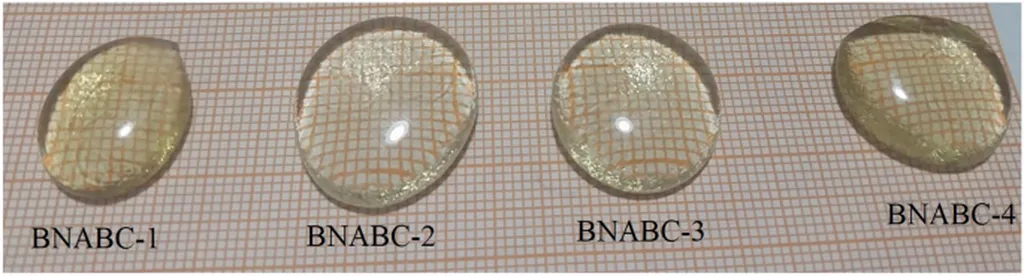
In the quest for safer and more sustainable radiation shielding materials, a team of researchers led by Mohamed Elsafi from the Physics Department at Alexandria University has made significant strides. Their work, published in Discover Materials (translated to English as “Exploring Materials”), focuses on the development of BaO-modified borate glasses with promising gamma-ray shielding properties. This research could have substantial implications for the energy sector, particularly in nuclear applications and medical diagnostics.
The study fabricated a series of barium borate glasses with varying concentrations of BaO, ranging from 9 to 21 mol%. These glasses were created using a standard melt-quenching process, where high-purity raw materials were melted at 1100°C and then annealed at 350°C for four hours. The resulting glasses were then tested for their gamma-ray attenuation properties using a high-purity germanium detector and gamma sources with energies ranging from 59.5 keV to 1333 keV.
The key to understanding the effectiveness of these glasses lies in their linear attenuation coefficient (LAC), a measure of how well a material can absorb radiation. The researchers found that as the concentration of BaO increased, the LAC values also rose, indicating better radiation shielding. “The linear rise in LAC with increasing BaO concentration is a clear indication of the enhanced attenuation efficiency of these glasses,” Elsafi explained.
The experimental data were validated using MCNP-5 Monte Carlo simulations, ensuring the accuracy of the measurements within an 8% margin of error. This validation process is crucial for establishing confidence in the results. The glasses with the highest BaO concentration, labeled BMZCe-4, showed the best performance, with the highest LAC and radiation protection efficiency (RPE) values. “BMZCe-4 demonstrated the highest level of shielding efficiency, making it a strong candidate for practical applications,” Elsafi noted.
The implications of this research are far-reaching. The development of effective and sustainable radiation shielding materials is critical for the energy sector, particularly in nuclear power plants and medical facilities where radiation exposure is a concern. The BaO-modified borate glasses offer a promising alternative to traditional lead-based shielding materials, which are not only heavy but also pose environmental risks.
“These glasses achieve more than acceptable levels of shielding efficiencies similar to commercial lead glass while maintaining environmental safety,” Elsafi stated. This sustainability aspect is particularly important as industries increasingly seek eco-friendly solutions.
The research also highlights the potential for future developments in the field. The use of Monte Carlo simulations for validating experimental data sets a precedent for future studies, ensuring that new materials are thoroughly tested and validated. This approach could accelerate the development of new shielding materials with even better performance characteristics.
As the energy sector continues to evolve, the need for innovative and sustainable solutions will only grow. The work of Elsafi and his team represents a significant step forward in this direction, offering a glimpse into a future where radiation shielding is both effective and environmentally responsible. With the publication of their findings in Discover Materials, the scientific community now has a new benchmark for the development of advanced shielding materials, paving the way for safer and more sustainable applications in the energy sector.