
In the bustling world of wireless communication, where data zips through the air at lightning speed, there’s an often overlooked challenge: electromagnetic interference (EMI). This interference can disrupt signals, causing malfunctions in electronic systems. Traditional EMI shielding materials, while effective, have a significant drawback—they block all frequencies indiscriminately, making them incompatible with the precise frequency needs of modern wireless technologies. Moreover, their lack of mechanical robustness has limited their use in wearable electronics. However, a groundbreaking study led by Donghee Kim from the School of Electrical Engineering at Korea University, published in the journal ‘npj Flexible Electronics’ (translated as ‘npj Flexible Electronics’), is set to change the game.
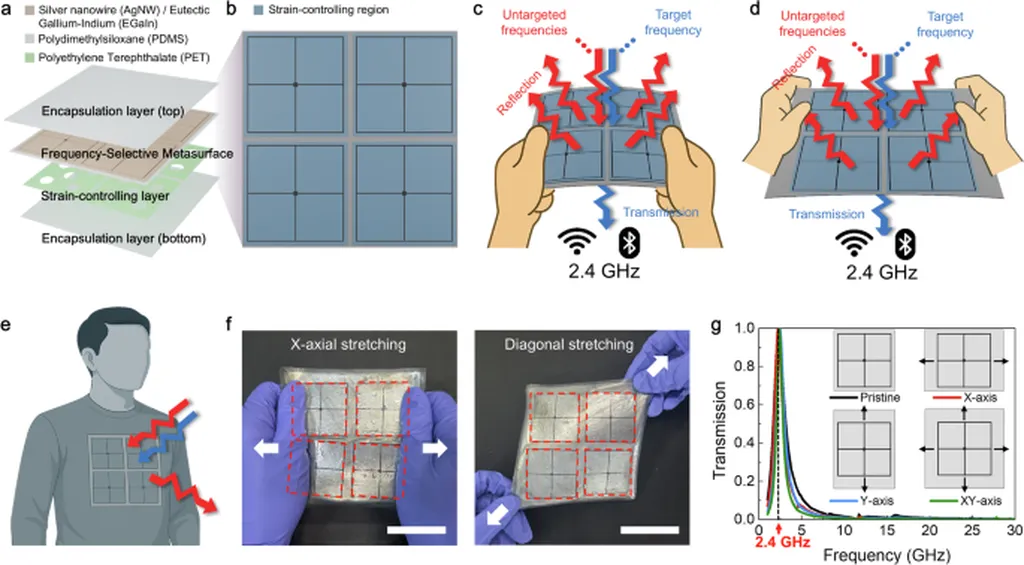
The research introduces a novel, wearable metasurface-based EMI shielding material that selectively transmits frequencies at 2.4 GHz—a common frequency used in Wi-Fi and Bluetooth—while attenuating broadband EMI across other frequencies. This selective approach ensures that desired signals are not blocked, while unwanted interference is effectively shielded. “Our goal was to create a material that could adapt to the complex electromagnetic environments of today’s wireless technologies,” Kim explains. “We wanted something that could protect electronic systems without compromising their functionality.”
The key to this innovation lies in the incorporation of a strain-controlling layer. This layer preserves the geometry of the metasurface unit cells, ensuring reliable electromagnetic performance even under mechanical deformation. The result is a material that maintains consistent frequency-selective transmission at 2.4 GHz and effective EMI shielding under biaxial strain. “This breakthrough opens up new possibilities for wearable electronics,” says Kim. “It’s a significant step towards integrating advanced electromagnetic technologies into deformable and textile-based electronic systems.”
The commercial implications of this research are substantial, particularly for the energy sector. As the demand for wearable electronics and smart devices continues to grow, so does the need for efficient and selective EMI shielding. This technology could revolutionize the way we design and use electronic devices, ensuring they function optimally in increasingly crowded electromagnetic environments. “The potential applications are vast,” Kim adds. “From healthcare monitoring devices to smart clothing, this technology could enhance the performance and reliability of a wide range of electronic systems.”
This research not only addresses the immediate need for better EMI shielding but also paves the way for future developments in the field. As wireless communication technologies continue to evolve, the demand for selective and adaptable shielding materials will only grow. The work of Kim and his team represents a significant stride towards meeting this demand, offering a glimpse into the future of wearable and flexible electronics.