
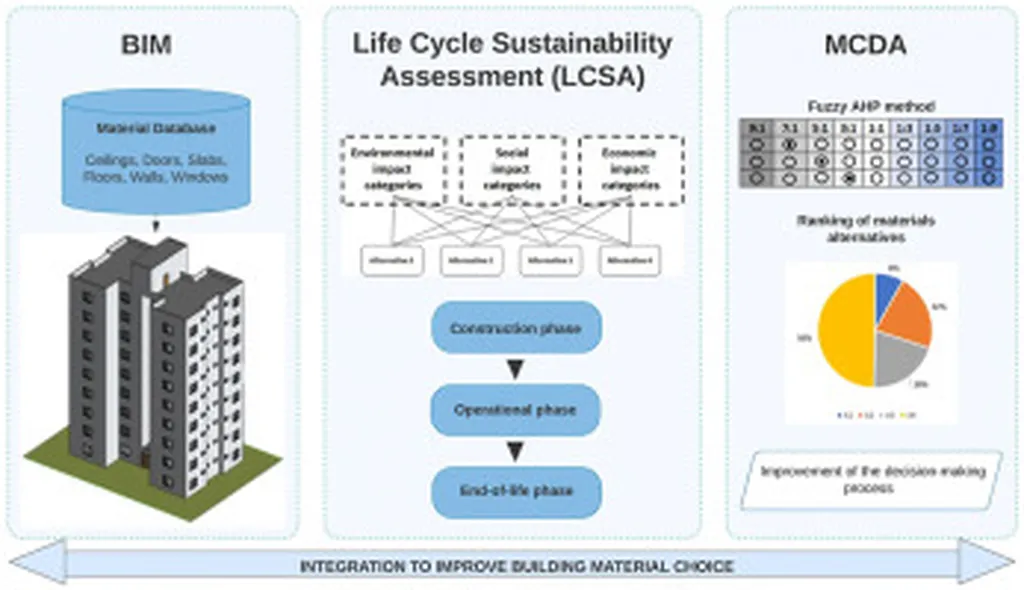
In the ever-evolving landscape of construction technology, a groundbreaking framework is poised to revolutionize how we assess building sustainability. Naji Alaa Jaleel, a researcher from the University of Al-Qadisiyah, has introduced a novel approach that integrates the Multi-Attributive Border Approximation Comparison (MABAC) method with Building Information Modelling (BIM). This innovative framework promises to streamline sustainability assessments, offering a comprehensive, quantitative evaluation that could significantly impact the energy sector and beyond.
The framework’s power lies in its ability to automate the generation, integration, and processing of material sustainability data within the BIM environment. “This automation not only saves time but also enhances the accuracy of sustainability assessments,” Jaleel explains. By employing the Best-Worst Method (BWM) to determine the relative weights of sustainability criteria, the framework ensures a balanced evaluation encompassing environmental, economic, and social dimensions.
One of the most compelling aspects of this research is its practical application. A case study demonstrated that alternative A2 outperformed other options in economic performance, achieving a 55% reduction in global warming potential and an 18% decrease in costs. “The analysis identified the wall category as having the highest environmental impact, followed by the slab and column categories,” Jaleel notes. This level of detail is crucial for stakeholders in the energy sector, where understanding the environmental impact of building materials can drive more sustainable and cost-effective decisions.
The integration of a functional database into the BIM environment, combined with scripts developed using Dynamo tools, enables automated calculation of specified sustainability criteria. This automation is a game-changer, as it allows for real-time assessments and continuous improvement in sustainability practices.
Published in the ‘Journal of Asian Architecture and Building Engineering’ (known in English as the Journal of Asian Architecture and Building Engineering), this research is set to shape future developments in the field. By providing a robust framework for sustainability assessments, it offers a tool that can be adapted to various types of buildings and indicators. This flexibility is key to its potential impact, as it allows for tailored assessments that meet the unique needs of different projects.
As the construction industry continues to evolve, the integration of advanced technologies like BIM and MABAC methods will be crucial in driving sustainability. Jaleel’s research highlights the importance of a holistic approach to sustainability assessments, one that considers not just environmental impact but also economic and social factors. This comprehensive perspective is essential for creating buildings that are not only sustainable but also economically viable and socially responsible.
In the energy sector, where sustainability is a growing priority, this framework offers a valuable tool for assessing and improving the environmental performance of buildings. By providing a clear, quantitative evaluation of sustainability, it enables stakeholders to make informed decisions that balance environmental, economic, and social considerations.
As we look to the future, the potential applications of this framework are vast. From residential buildings to commercial structures, the ability to conduct comprehensive sustainability assessments can drive innovation and improve outcomes across the board. By embracing these advanced technologies, the construction industry can take significant steps towards a more sustainable and efficient future.
In the words of Jaleel, “This framework is not just about assessing sustainability; it’s about enabling better decision-making and driving progress towards a more sustainable built environment.” With its potential to transform sustainability assessments, this research is a beacon of innovation in the construction industry, offering a path forward that is both promising and achievable.