
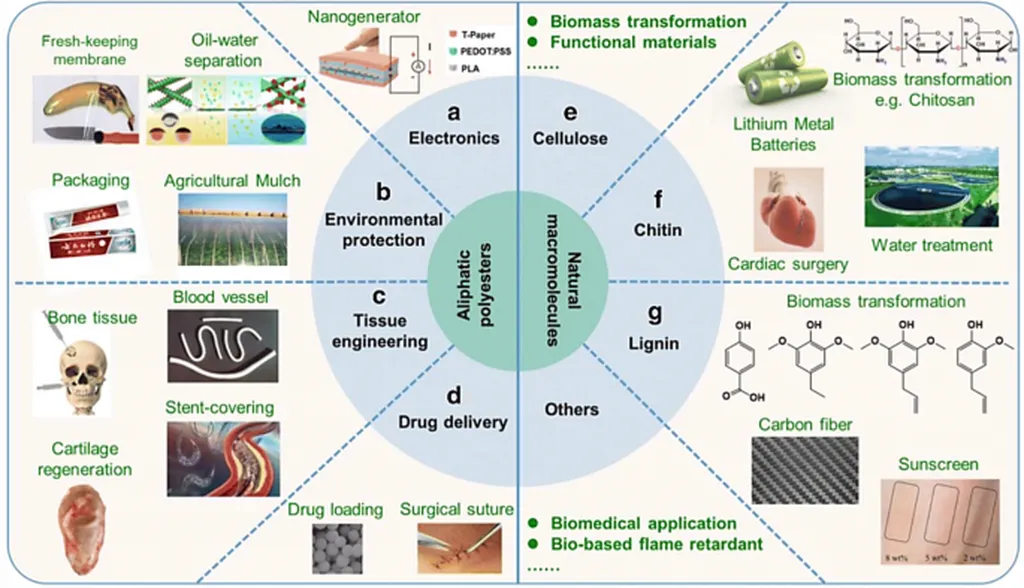
In the quest for sustainable materials, two biodegradable polymers, polylactic acid (PLA) and poly(butylene adipate-co-terephthalate) (PBAT), have emerged as frontrunners in industries ranging from packaging to agriculture. Yet, their long-term durability under real-world conditions has remained a critical question. A recent study published in the journal *eXPRESS Polymer Letters* (which translates to “Polymer Letters Express”) sheds light on how these materials degrade over time, offering valuable insights for engineers and manufacturers.
The research, led by Nikita V. Eremin, investigated the effects of ultraviolet (UV) radiation and elevated temperatures on PLA and PBAT. Using a custom-designed setup, the team subjected the polymers to accelerated ageing for 24, 120, and 240 hours. Their findings reveal stark differences in how these materials weather the elements.
PLA, known for its rapid degradation, showed significant surface damage within just 120 hours, with cracks and voids forming. By 240 hours, the material was heavily damaged, riddled with cavities. In contrast, PBAT degraded more gradually, with large cracks and cavities appearing only after 240 hours. “The rapid degradation of PLA is a double-edged sword,” notes Eremin. “While it makes PLA ideal for short-term applications, its quick breakdown under UV exposure poses challenges for long-term durability.”
The study employed scanning electron microscopy, Fourier transform infrared spectroscopy, and tensile testing to provide a comprehensive assessment of the changes. For PLA, early ageing led to a shift and broadening of the carbonyl band, indicating disorder and ester scission. PBAT, on the other hand, showed a decrease in the intensity of the carbonyl shoulder and a slight shift of the main peak at elevated temperatures, suggesting phase redistribution and the formation of new functional groups.
Mechanically, PLA exhibited a sharp loss of strength and ductility within the first day of ageing, while PBAT demonstrated greater stability. Although PBAT’s stiffness and strength declined more slowly, its elongation at break showed a strong temperature-dependent decrease.
These findings have significant implications for the energy sector, particularly in packaging and agricultural applications where materials are exposed to harsh environmental conditions. Understanding how these polymers degrade can guide the design of more durable biodegradable materials, reducing waste and improving sustainability.
As the world shifts towards greener alternatives, research like Eremin’s is crucial. “Our goal is to provide a scientific foundation for developing materials that are not only eco-friendly but also robust enough to meet industry demands,” Eremin explains. By unraveling the complexities of polymer degradation, this study paves the way for innovations that could redefine the future of sustainable materials.