
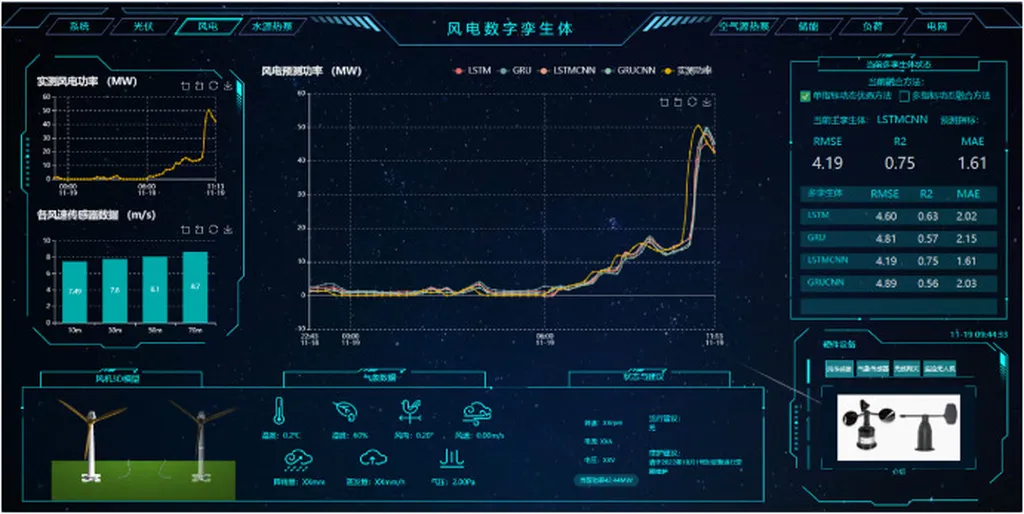
In the quest to harness the full potential of wind energy, researchers have turned to digital twin technology to revolutionize ultra-short-term wind power prediction. Aotian Yuan, a researcher at the School of Energy and Electrical Engineering at Qinghai University in China, has developed a novel model that promises to enhance the accuracy of wind power forecasting, a critical factor for grid stability and energy market operations.
The traditional methods of wind power prediction often fall short because they overlook the intricate physical characteristics of wind turbines and the unique meteorological features of wind farms. Yuan’s model, published in the IET Renewable Power Generation (a journal focused on renewable energy generation technologies), addresses this gap by integrating a digital-physical model of the wind turbine with a sophisticated deep learning module.
The digital twin framework captures spatiotemporal features in the data, while the digital-physical model couples the forecasting process with the actual physical conditions of the wind farm. This dual approach significantly improves prediction precision, offering a more reliable tool for energy sector professionals.
“The integration of digital twin technology with deep learning models allows us to bridge the gap between theoretical predictions and real-world conditions,” Yuan explains. “This not only enhances the accuracy of our forecasts but also provides a more robust tool for decision-making in the energy sector.”
The implications for the energy sector are substantial. Accurate ultra-short-term wind power predictions are crucial for grid operators to balance supply and demand, ensuring stable and efficient energy distribution. For energy traders, precise forecasts enable better market participation and risk management. Moreover, improved prediction accuracy can lead to more effective integration of renewable energy sources into the grid, reducing reliance on fossil fuels and promoting a cleaner energy future.
Yuan’s research also highlights the potential for future developments in the field. As digital twin technology continues to evolve, its applications in renewable energy are expected to expand. The integration of advanced sensors, IoT devices, and machine learning algorithms can further enhance the accuracy and reliability of wind power predictions, paving the way for a more sustainable and efficient energy landscape.
In the words of Yuan, “The future of wind power prediction lies in the seamless integration of digital and physical models, leveraging the power of data and advanced analytics to drive innovation in the energy sector.”
As the energy sector continues to evolve, the work of researchers like Aotian Yuan will play a pivotal role in shaping a more sustainable and efficient future. The integration of digital twin technology with deep learning models represents a significant step forward in the quest for accurate wind power predictions, offering a glimpse into the transformative potential of data-driven solutions in the renewable energy landscape.