
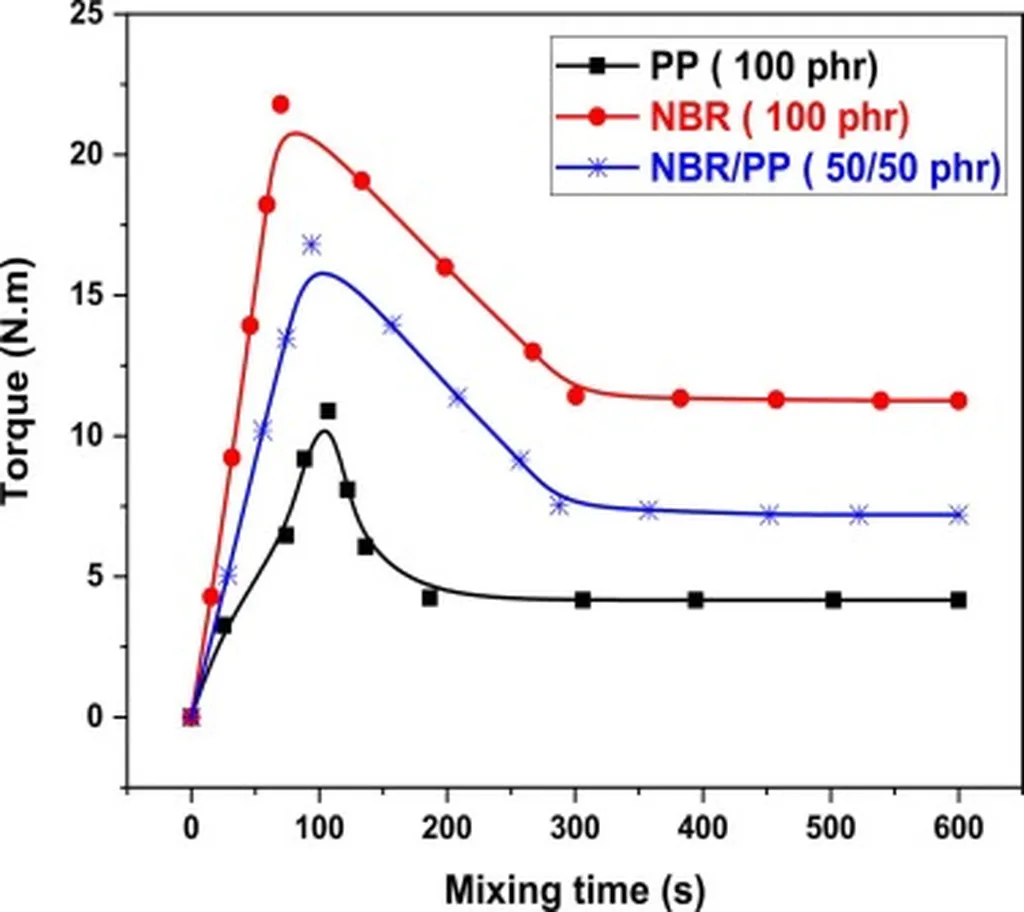
In the quest to enhance the performance of rubber blends, a team of researchers led by Abdulhakim Masa has made a significant breakthrough. The study, published in the journal *eXPRESS Polymer Letters* (which translates to “Polymer Letters Express”), focuses on improving the compatibility between natural rubber (NR) and acrylonitrile butadiene rubber (NBR), two materials widely used in various industrial applications, including the energy sector.
The challenge lies in the inherent incompatibility between NR and NBR due to their differing polarities, which often results in poor mechanical properties. To address this issue, Masa and his team developed a novel compatibilizer called G10, which is poly(vinyl propionate)-grafted natural rubber (NR-g-PVP) containing 10 wt% PVP. This innovative approach aims to bridge the gap between the two types of rubber, enhancing their overall performance.
“By using G10 as a compatibilizer, we observed a significant improvement in the mechanical properties of the NR/NBR blends,” Masa explained. The results were striking: the glass transition temperatures (Tg) of NR and NBR shifted towards each other, indicating that G10 interacts effectively with both rubber phases. This interaction led to a more homogeneous blend with a smooth surface morphology, which is crucial for industrial applications.
The mechanical properties of the blend, including 300 and 500% moduli, tensile strength, and tear resistance, all showed marked improvements with the addition of G10. The optimal concentration of G10 was found to be 7.5 parts per hundred rubber (phr), which resulted in a tensile strength increase of approximately 40.7% compared to the control sample.
The implications of this research are far-reaching, particularly for the energy sector. Rubber blends are essential components in various energy applications, from seals and gaskets to hoses and belts. The enhanced compatibility and mechanical properties achieved through the use of G10 could lead to more durable and efficient materials, ultimately reducing maintenance costs and improving overall performance.
“This study opens up new possibilities for the development of high-performance rubber blends,” Masa noted. “The use of NR-g-PVP as a compatibilizer not only improves the mechanical properties but also paves the way for more sustainable and cost-effective solutions in the energy sector.”
As the energy industry continues to evolve, the demand for advanced materials that can withstand harsh conditions and provide long-lasting performance is on the rise. The research conducted by Masa and his team represents a significant step forward in meeting these demands, offering a promising solution for the future of rubber blends in energy applications.