
In the rapidly evolving landscape of renewable energy, photovoltaic (PV) systems are taking center stage, and a recent study published in the *IET Renewable Power Generation* (formerly known as the *IET Renewable Power Generation Journal*) is shedding new light on a critical component of these systems: transformerless grid-connected inverters. The research, led by Sahaya Ponrekha A. from the Karunya Institute of Technology and Sciences in Coimbatore, India, delves into the intricate world of transformerless inverters, offering a comprehensive review and comparative analysis that could reshape the future of PV energy systems.
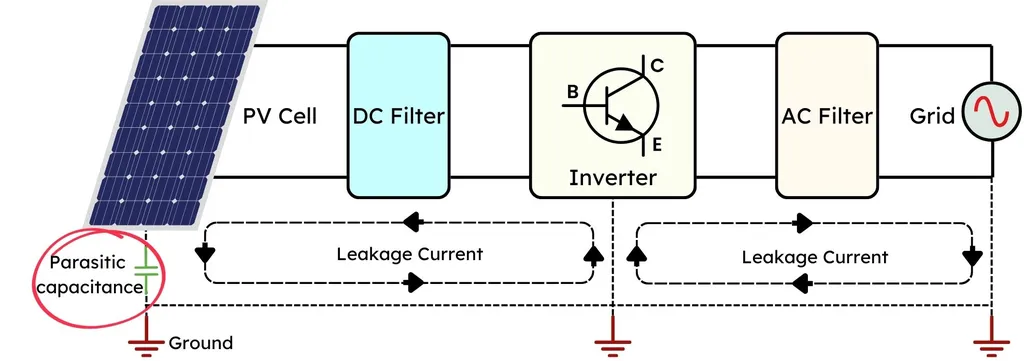
Transformerless inverters have gained traction in the industry due to their higher efficiency, lower cost, and compact size compared to their transformer-equipped counterparts. However, they come with a significant challenge: leakage current generation. This issue has been a stumbling block in the widespread adoption of transformerless inverters, but Ponrekha’s research aims to change that.
The study categorizes transformerless inverters based on their structures and subcategorizes them by leakage current reduction techniques. Ponrekha and her team have meticulously differentiated the components and connections of these inverters using color-coding, making the operation of these complex systems more understandable. “We wanted to make the intricate details of these inverters accessible to a broader audience,” Ponrekha explains. “By color-coding the components, we hope to simplify the understanding of how these systems work and how they can be improved.”
The research also presents detailed comparisons of transformerless inverters based on their performance and construction, highlighting their strengths and weaknesses. To provide deeper insights, the team simulated selected inverters under various operating conditions and analyzed the loss contribution of each switch. This granular analysis is invaluable for new researchers, designers, and engineers looking to develop more efficient topologies.
So, what does this mean for the energy sector? The implications are substantial. As Ponrekha notes, “Understanding and mitigating leakage current in transformerless inverters can lead to more efficient and cost-effective PV systems. This could accelerate the adoption of solar energy, bringing us closer to a sustainable energy future.”
The study’s findings could pave the way for innovative solutions that enhance the performance of transformerless inverters, making them a more viable option for grid-connected PV systems. This, in turn, could drive down the costs of solar energy, making it more accessible and attractive to both commercial and residential consumers.
In the competitive world of renewable energy, every advancement counts. Ponrekha’s research is a significant step forward, offering a detailed roadmap for improving transformerless inverters and, by extension, the entire PV energy system. As the industry continues to evolve, studies like this will be crucial in shaping the future of energy generation and distribution.
For those in the energy sector, the message is clear: the future of PV systems lies in the development of efficient, cost-effective, and reliable transformerless inverters. And with the insights provided by Ponrekha and her team, that future is looking brighter than ever.