
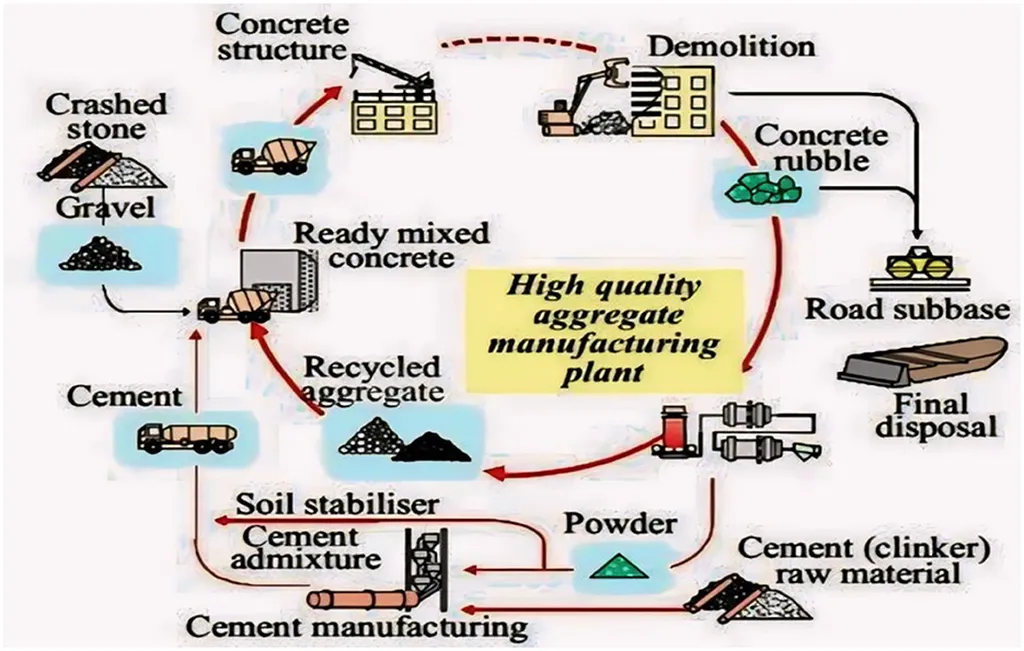
In the heart of the Jordanian construction sector, a significant stride is being made towards enhancing waste management practices, with potential ripple effects across the global construction and energy sectors. Mohammad K. Younes, from the Department of Environment and Safety at the Arab Potash Company, has spearheaded a pioneering study published in the Tikrit Journal of Engineering Sciences (translated to English as the Journal of Engineering Sciences from Tikrit University) that promises to revolutionize how construction and demolition (C&D) waste is managed.
Younes’s research addresses a critical gap in the Jordanian construction industry: the lack of effective waste management and inventory systems. With Jordan’s population growth showing no signs of abating, the construction sector’s role in economic development is more pivotal than ever. “The current lack of waste management strategies is not only an environmental concern but also a significant economic oversight,” Younes asserts.
The study introduces a novel model to quantify C&D waste, categorizing projects into construction and infrastructure, and further subdividing construction projects into new builds, renovations, or rehabilitations. This hyper-categorization allows for more precise waste management, ultimately reducing costs and environmental impact. “By understanding the specific types of waste generated by different project categories, we can develop targeted strategies to minimize waste and maximize recycling potential,” Younes explains.
A comprehensive survey among construction stakeholders revealed varying degrees of awareness and readiness to adopt C&D waste management activities. The findings underscore the need for increased education and advocacy within the industry. To this end, Younes conducted a SWOT (Strengths, Weaknesses, Opportunities, and Threats) analysis to identify challenges and opportunities in C&D waste management. The analysis highlights hidden opportunities that could drive the development of future waste management plans.
One of the most compelling findings is the potential revenue from recycling C&D waste, estimated at approximately US$4.2 per square meter of construction. This figure not only underscores the economic viability of waste recycling but also highlights the untapped potential within the construction sector. “The financial benefits of recycling C&D waste are substantial,” Younes notes. “This revenue can be reinvested into more sustainable practices, creating a circular economy that benefits both the environment and the bottom line.”
The implications of this research extend beyond Jordan’s borders. As global construction activities continue to rise, the need for effective waste management strategies becomes increasingly urgent. Younes’s model offers a blueprint for other regions to follow, potentially transforming the way the construction industry approaches waste management worldwide.
Moreover, the study’s focus on the circular economy aligns with broader sustainability goals, offering a pathway to reduce the environmental footprint of construction activities. By promoting recycling and reusing materials, the construction sector can contribute to a more sustainable future, reducing the demand for virgin resources and minimizing waste sent to landfills.
The commercial impacts for the energy sector are also noteworthy. Efficient waste management can lead to the recovery of valuable materials, reducing the need for energy-intensive extraction processes. Additionally, the recycling of C&D waste can generate energy through processes like waste-to-energy conversion, providing a renewable energy source that aligns with global decarbonization efforts.
As the construction industry grapples with the challenges of sustainability and economic viability, Younes’s research offers a beacon of hope. By providing a clear, actionable framework for waste management, the study paves the way for a more sustainable and economically robust construction sector. The insights gained from this research have the potential to shape future developments, driving innovation and fostering a more responsible approach to construction and demolition waste management.
In the words of Younes, “This research is not just about managing waste; it’s about creating a sustainable future for the construction industry and the planet.” As the world looks towards a greener horizon, studies like this one are instrumental in guiding the way forward.