
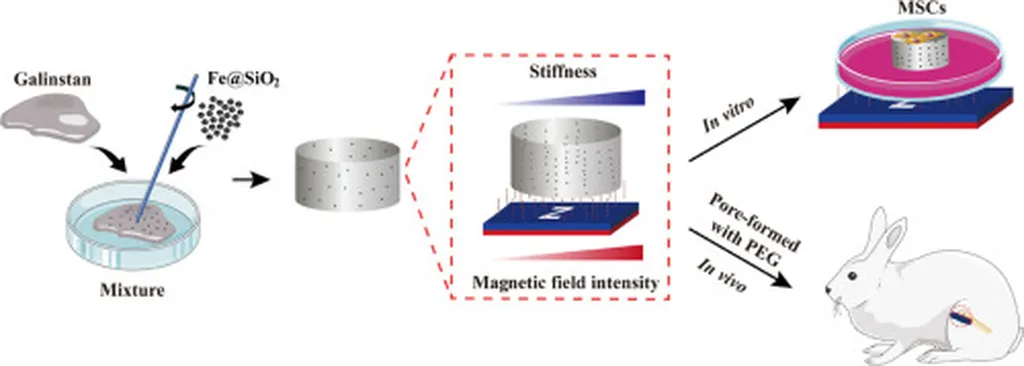
In the bustling world of tissue engineering, a quiet revolution is brewing, and it’s not driven by biology alone. Researchers are harnessing the power of innovative magnetic materials to create dynamic platforms that could reshape regenerative medicine. At the forefront of this movement is Chunyu Su, a researcher from the Shaanxi Key Laboratory for Animal Conservation at Northwest University in Xi’an, China. Su and his team have published a comprehensive review in the journal *Materials & Design* (which translates to *Materials & Design* in English), shedding light on the transformative potential of these materials.
The review, titled “Innovative magnetic materials in tissue engineering: A review on revolutionizing regenerative strategies,” delves into the cutting-edge advancements in magnetic materials that are enabling unprecedented control over regenerative processes. These materials, ranging from superparamagnetic iron oxide nanoparticles (SPIONs) to magneto-responsive hydrogels and 4D-printed shape-memory alloys, are opening up new avenues for targeted therapy, controlled mechano-transduction, and mild thermal stimulation.
“These materials are not just passive scaffolds; they are dynamic platforms that can respond to external magnetic fields,” Su explains. “This responsiveness allows us to control the behavior of cells and the release of drugs with remarkable precision.”
The implications for tissue engineering are profound. Imagine a scaffold that can be remotely controlled to release drugs on demand, or a material that can guide the differentiation of stem cells into specific types of tissue. These are not just theoretical possibilities; they are realities that are being explored and developed right now.
One of the most exciting aspects of this research is its potential to enhance the regeneration of complex tissues like bone, nerve, and cartilage. In preclinical models, these magnetic materials have already shown significantly improved healing outcomes. This could have a profound impact on the energy sector, particularly in areas like biofuel production and environmental remediation, where tissue engineering could play a crucial role.
However, the path to clinical translation is not without its challenges. Su and his team outline the current hurdles, including the need for integrated multi-functional platforms and scalable manufacturing processes. But the future trajectories are promising, and the potential for these materials to revolutionize regenerative medicine is immense.
As Su puts it, “We are at the dawn of a new era in tissue engineering. The integration of magnetic materials is not just a step forward; it’s a leap into a future where we can precisely control and enhance the body’s natural healing processes.”
This research is a testament to the power of interdisciplinary collaboration, bringing together experts from materials science, biology, and engineering to push the boundaries of what’s possible. As we look to the future, the potential applications of these magnetic materials are limited only by our imagination. And with researchers like Chunyu Su leading the way, the possibilities are endless.